Grok
Source: https://grok.com/c/ab1efe0b-4a24-4297-8581-3d2e6bce6384?rid=67209304-bb44-49ba-a1cd-aed8c1525e1d
Gauss's Law for Electricity (one of Maxwell's equations) states that the net electric flux through any closed surface is proportional to the total electric charge enclosed by that surface.
Integral Form (for context)
∮SE⋅dA=Qencϵ0\oint_S \mathbf{E} \cdot d\mathbf{A} = \frac{Q_{\rm enc}}{\epsilon_0}
E \mathbf{E} : electric field vector
dA d\mathbf{A} : outward area element vector on the closed surface S S
Qenc Q_{\rm enc} : total charge inside the surface
ϵ0≈8.854×10⁻¹² F/m \epsilon_0 \approx 8.854 \times 10^{-12} , \rm F/m : vacuum permittivity
This form is powerful for symmetric problems because the flux can often be simplified to E×A E \times A or similar.
The Basics of Electric Flux and Gauss's Law | CircuitBread
Illustration: A closed Gaussian surface (the box) enclosing a positive charge +q +q . Electric field lines point outward in all directions — the net flux is positive and equals q/ϵ0 q/\epsilon_0 .
Differential Form (Partial Derivative Form)
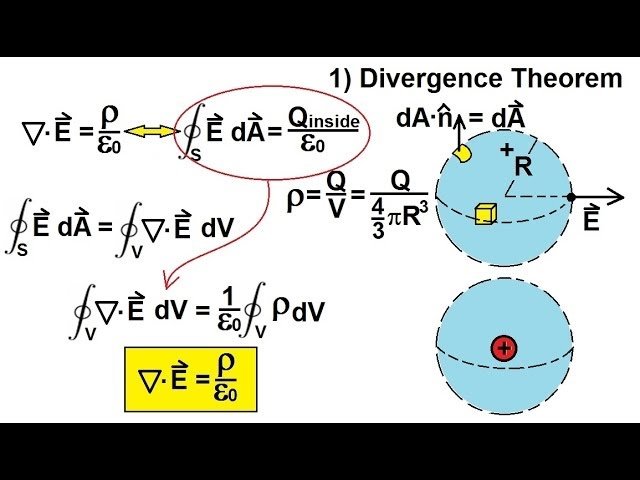
Applying the divergence theorem (also called Gauss's theorem) to the integral form converts the global surface integral into a local point-by-point equation:
∇⋅E=ρϵ0\nabla \cdot \mathbf{E} = \frac{\rho}{\epsilon_0}
In Cartesian coordinates (fully expanded partial derivative form):
∂Ex∂x+∂Ey∂y+∂Ez∂z=ρϵ0\frac{\partial E_x}{\partial x} + \frac{\partial E_y}{\partial y} + \frac{\partial E_z}{\partial z} = \frac{\rho}{\epsilon_0}
Physics 46 Maxwell's Equations (9 of 30) Differential Form of Gauss' Law: 1
Expanded terms explained:

Left side — Divergence of E \mathbf{E} :∇⋅E=∂Ex∂x+∂Ey∂y+∂Ez∂z\nabla \cdot \mathbf{E} = \frac{\partial E_x}{\partial x} + \frac{\partial E_y}{\partial y} + \frac{\partial E_z}{\partial z}This scalar quantity measures the net "outflow" of the electric field at a point.
Positive value → field lines originate (source = positive charge)
Negative value → field lines terminate (sink = negative charge)
Zero → field lines are continuous or balanced (no net source/sink)
Right side — ρ/ϵ0 \rho / \epsilon_0 :
ρ(x,y,z) \rho(x,y,z) = volume charge density (C/m³) at that exact point in space.
ϵ0 \epsilon_0 converts charge density into the corresponding field divergence.
This is a local equation — it must hold at every point in space. It is the form used in theoretical derivations, numerical simulations, and when combining with other Maxwell equations.
Key Applications of Gauss's Law
- Analytic calculation of electric fields (symmetry cases)
Choose a Gaussian surface that matches the symmetry so E \mathbf{E} is constant on faces and flux is easy to compute.
Spherical symmetry (point charge, uniformly charged sphere or spherical shell):
Outside a point charge or sphere: E=14πϵ0Qr2 E = \frac{1}{4\pi\epsilon_0}\frac{Q}{r^2} (Coulomb's law).
Inside a charged spherical shell: E=0 E = 0 .
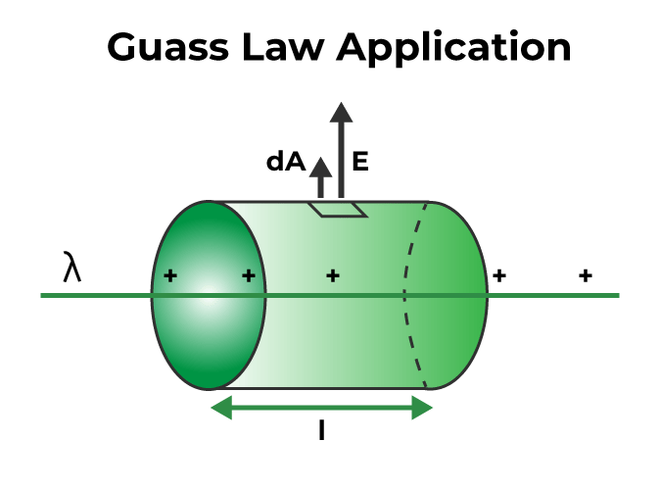
Cylindrical symmetry (infinite line charge or long charged cylinder):E=λ2πϵ0r(radial outward)E = \frac{\lambda}{2\pi \epsilon_0 r} \quad \text{(radial outward)}
Gauss's Law - GeeksforGeeks
Illustration: Cylindrical Gaussian surface around an infinite line charge λ \lambda . The curved wall has constant E E , end caps have zero flux (by symmetry).
Planar symmetry (infinite charged sheet or parallel-plate capacitor):
E=σ2ϵ0 E = \frac{\sigma}{2\epsilon_0} (constant, perpendicular to the sheet; direction depends on sign of σ \sigma ).
- Electrostatic shielding & Faraday cages
Inside the material of a conductor in electrostatic equilibrium, E=0 \mathbf{E} = 0 . By Gauss's law, any Gaussian surface inside the conductor encloses zero net charge. This proves:
Excess charge resides only on the outer surface.
A hollow conductor shields its interior from external electric fields (Faraday cage).
- Derivation of Coulomb's inverse-square law
Start from the differential form + spherical symmetry → recover E∝1/r2 E \propto 1/r^2 . - Dielectrics and capacitors
Generalized form: ∇⋅D=ρfree \nabla \cdot \mathbf{D} = \rho_{\rm free} , where D=ϵ0E+P \mathbf{D} = \epsilon_0\mathbf{E} + \mathbf{P} . Used to calculate capacitance with dielectric materials between plates. - Computational electromagnetics & numerical methods
The differential form is discretized (finite difference, finite element) to solve Poisson's equation
∇2ϕ=−ρϵ0\nabla^2 \phi = -\frac{\rho}{\epsilon_0}
for the potential ϕ \phi (where E=−∇ϕ \mathbf{E} = -\nabla\phi ) in complex geometries (IC design, particle accelerators, high-voltage equipment). - Theoretical consistency
Combined with the continuity equation and Maxwell's other equations, it guarantees charge conservation and is foundational to electromagnetic wave theory. - High-voltage / plasma / experimental contexts
Explains charge concentration at sharp points (corona discharge), field behavior inside conductors, and shielding in experimental setups involving high electric fields.
Gauss's law (especially the differential form) is one of the most elegant and useful equations in physics because it directly links the local source (charge density) to the field behavior everywhere.
🔐 Cryptographic Verification
Archived URL: https://grok.com/c/ab1efe0b-4a24-4297-8581-3d2e6bce6384?rid=67209304-bb44-49ba-a1cd-aed8c1525e1d
📄 CONTENT HASHES:
  SHA-256:  00e0f622c9be4d2ccc0305aa6db98b6a178337b402709f33d042668da8b44fef
  BLAKE2b:  d086709eb2c20d895f346d698955857ba260734006048dabfd7f09d475dcb2e1
  MD5:      501deb0d595d8abac7760722c8c6fd4c

📝 TITLE HASHES:
  SHA-256:  dca61d32363b091bf130e0b539eaa6557a3a035be17a1be1e3dc2c183eafcd2f
  BLAKE2b:  93b372066f2f6799a21deac75705fc3bdaef053cebdd78253ae7e020e9de9b91
  MD5:      6626db256698f843db48e4e46ad4ea64

🔒 INTEGRITY HASHES:
  SHA-256:  8ac494fa0716b769b7bcc978cbacac104ef3eb8460b634a432d1ff8768b464de
  BLAKE2b:  b3ddf99b50009e167da63f99937ab848716469f74bfa9cc82b83dc2c15cd83f4
  MD5:      3082c4333b80635c5d6e81a5dd86af3a
Archived with ArcHive - Client-side cryptographic archival system