▶️Watch on 3Speak - Odysee - BitChute - Rumble - YouTube - PDF notes
In this video I go over Question 3 of the Laboratory Project: Taylor Polynomials, and this time revisit the quadratic approximation but instead use a slightly different notation. In Question 1 I illustrated how the quadratic or parabola or 2nd order polynomial approximation P(x) = A + Bx + Cx2 can be used to approximate a function f(x) at x = a, with the conditions that P(a) = f’(a), P’(a) = f’(a), and P’’(a) = f’’(a). But in this video I show that it is often preferable to use a slightly different notation and instead use P(x) = A + B(x – a) + C(x – a)2. The only difference in using this form is that the constants A, B, C will not necessarily be the same. This notation has the benefit in that determine the constants with the 3 conditions listed above is fairly easy because when we input x = a into P(x) or its derivative, most terms vanish because a – a = 0.
When we solve for the constants, I show that we obtain the function P(x) = f(a) + f’(a)(x – a) + f’’(a)(x – a)2, which is a very convenient form to determine the constants, just from f(x) and its derivatives at x = a. Furthermore, this is the basis for Taylor Polynomials which I will be illustrating in further parts of this Laboratory Project, so make sure to watch this video and fully understand this concept!
Laboratory Project playlist
View Video Notes Below!
Become a MES Super Fan - Donate - Subscribe via email - MES merchandise
Reuse of my videos:
- Feel free to make use of / re-upload / monetize my videos as long as you provide a link to the original video.
Fight back against censorship:
- Bookmark sites/channels/accounts and check periodically.
- Remember to always archive website pages in case they get deleted/changed.
Recommended Books: "Where Did the Towers Go?" by Dr. Judy Wood
Join my forums: Hive community - Reddit - Discord
Follow along my epic video series: MES Science - MES Experiments - Anti-Gravity (MES Duality) - Free Energy - PG
NOTE 1: If you don't have time to watch this whole video:
- Skip to the end for Summary and Conclusions (if available)
- Play this video at a faster speed.
-- TOP SECRET LIFE HACK: Your brain gets used to faster speed!
-- MES tutorial- Download and read video notes.
- Read notes on the Hive blockchain $HIVE
- Watch the video in parts.
-- Timestamps of all parts are in the description.Browser extension recommendations: Increase video speed - Increase video audio - Text to speech (Android app) – Archive webpages
Laboratory Project: Taylor Polynomials: Question 3

The tangent line approximation L(x) is the best first-degree (linear) approximation to f(x) near x = a because f(x) and L(x) have the same rate of change (derivative) at a.

For a better approximation than a linear one, let's try a second-degree (quadratic) approximation P(x).
In other words, we approximate a curve by a parabola instead of a straight line.
To make sure that the approximation is a good one, we stipulate the following:
i) P(a) = f(a) P and f should have the same value at a.
ii) P'(a) = f'(a) P and f should have the same rate of change at a.
iii) P"(a) = f"(a) The slopes of P and f should change at the same rate at a.
Question 1
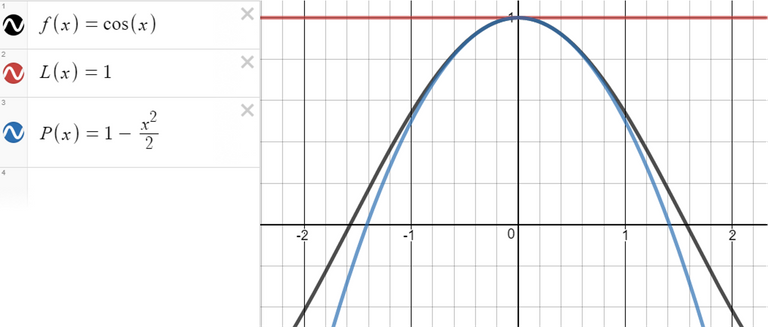
Find the quadratic approximation P(x) = A + B x + C x2 to the function f(x) = cos x that satisfies conditions i), ii), and iii) with a = 0.
Graph P, f and the linear approximation L(x) = 1 on a common screen.
Comment on how well the functions P and L approximate f.
Solution to Question 1:
https://www.desmos.com/calculator/qjplykp3pp
Retrieved: 14 October 2017
Archive: Not Available
Question 2
Determine the values of x for which the quadratic approximation f(x) = P(x) in Problem 1 is accurate to within 0.1.
Hint: Graph y = P(x), y = cos x - 0.1, and y = cos x + 0.1 on a common screen.
Solution to Question 2:
https://www.desmos.com/calculator/x09qfry3wl
Retrieved: 14 October 2017
Archive: Not Available
The approximation cos x ≈ 1 - x2/2 is accurate to within 0.1 within -1.26 < x < 1.26.
Question 3
To approximate a function f by a quadratic function P near a number a, it is best to write P in the form:
P(x) = A + B(x - a) + C(x - a)2.
Show that the quadratic function that satisfies conditions (i), (ii), (iii) is:
P(x) = f(a) + f'(a)(x - a) + ½ f"(a)(x - a)2
Solution to Question 3:

