▶️Watch on 3Speak - Odysee - BitChute - Rumble - DTube - YouTube - PDF notes
In this video I go over Question 6 of the Laboratory Project: Taylor Polynomials and this time look at an example on how to apply Taylor Polynomials to approximate the function f(x) = cos(x) centered at x = a = 0. This example involves determining the 8th degree polynomial and comparing it graphically with the 2nd, 4th, and 6th degree approximations. The first step in solving for the 8th degree Taylor Approximation is to take the derivatives up to the 8th derivative and solve each one for when x = a = 0. Doing so we can clearly see a pattern since the derivatives of cos(x) involve alternating sin(x) and cos(x) functions but with varying positive or negative signs. Since sin(0) = 0, I show that the odd terms, given the first term is considered even or zero, all vanish thus greatly simplifying the final formula. The 2nd, 4th, and 6th Taylor Approximations are all simply determined from the 8th degree Taylor Approximation since each successive iteration just adds a new term to the formula. Graphing the approximations all together with the function f(x) = cos(x) and centered about x = a = 0, I show that the approximations gets better and better for each successive iteration especially as the interval gets larger and larger. This is a very careful and detailed video showing how to approach and apply Taylor Polynomials in approximating a given function, so make sure to watch this video!
- Laboratory Project playlist: https://www.youtube.com/playlist?list=PLai3U8-WIK0GMTZJWnswRe2BYAL-Y2CeB
View Video Notes Below!
Become a MES Super Fan - Donate - Subscribe via email - MES merchandise
Reuse of my videos:
- Feel free to make use of / re-upload / monetize my videos as long as you provide a link to the original video.
Fight back against censorship:
- Bookmark sites/channels/accounts and check periodically.
- Remember to always archive website pages in case they get deleted/changed.
Recommended Books: "Where Did the Towers Go?" by Dr. Judy Wood
Join my forums: Hive community - Reddit - Discord
Follow along my epic video series: MES Science - MES Experiments - Anti-Gravity (MES Duality) - Free Energy - PG
NOTE 1: If you don't have time to watch this whole video:
- Skip to the end for Summary and Conclusions (if available)
- Play this video at a faster speed.
-- TOP SECRET LIFE HACK: Your brain gets used to faster speed!
-- MES tutorial- Download and read video notes.
- Read notes on the Hive blockchain $HIVE
- Watch the video in parts.
-- Timestamps of all parts are in the description.Browser extension recommendations: Increase video speed - Increase video audio - Text to speech (Android app) – Archive webpages

Laboratory Project: Taylor Polynomials: Question 6
The tangent line approximation L(x) is the best first-degree (linear) approximation to f(x) near x = a because f(x) and L(x) have the same rate of change (derivative) at a.

For a better approximation than a linear one, let's try a second-degree (quadratic) approximation P(x).
In other words, we approximate a curve by a parabola instead of a straight line.
To make sure that the approximation is a good one, we stipulate the following:
i) P(a) = f(a): P and f should have the same value at a.
ii) P'(a) = f'(a): P and f should have the same rate of change at a.
iii) P"(a) = f"(a): The slopes of P and f should change at the same rate at a.
Question 1
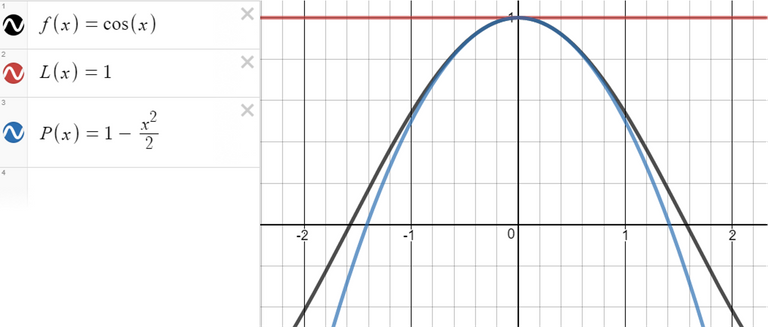
Find the quadratic approximation P(x) = A + B x + C x2 to the function f(x) = cos x that satisfies conditions i), ii), and iii) with a = 0.
Graph P, f and the linear approximation L(x) = 1 on a common screen.
Comment on how well the functions P and L approximate f.
Solution to Question 1
https://www.desmos.com/calculator/qjplykp3pp
Retrieved: 14 October 2017
Archive: Not Available
Question 2
Determine the values of x for which the quadratic approximation f(x) = P(x) in Problem 1 is accurate to within 0.1.
Hint: Graph y = P(x), y = cos x - 0.1, and y = cos x + 0.1 on a common screen.
Solution to Question 2
https://www.desmos.com/calculator/x09qfry3wl
Retrieved: 14 October 2017
Archive: Not Available
The approximation cos x ≈ 1 - x2/2 is accurate to within 0.1 within -1.26 < x < 1.26.
Question 3
To approximate a function f by a quadratic function P near a number a, it is best to write P in the form:
P(x) = A + B(x - a) + C(x - a)2.
Show that the quadratic function that satisfies conditions (i), (ii), (iii) is:
P(x) = f(a) + f'(a)(x - a) + ½ f"(a)(x - a)2
Question 4
Find the quadratic approximation to f(x) = (x + 3)1/2 near a = 1.
Graph f, the quadratic approximation, and the linear approximation from my earlier video titled "Linear Approximation: Example on Square Roots" on a common screen.
What do you conclude?
Solution to Question 4
https://www.desmos.com/calculator/e6b0kmb372
Retrieved: 21 October 2017
Archive: Not Available

Clearly the quadratic approximation is better than the linear one.
Question 5
Instead of being satisfied with a linear or quadratic approximation to f(x) near x = a, let's try to find better approximations with higher-degree polynomials.
We look for an nth-degree polynomial:
Tn(x) = c0 + c1(x - a) + c2(x - a)2 + c3(x - a)3 + … + cn(x - a)n
such that Tn and its first n derivatives have the same values at x = a as f and its first n derivatives.
By differentiating repeatedly and setting x = a, show that these conditions are satisfied if c0 = f(a), c1 = f'(a), c2 = ½ f''(a), and in general:

where k! = 1·2·3·4· … · k.
The resulting polynomial:

is called the nth-degree Taylor Polynomial of f centered at a.
Question 6
Find the 8th-degree Taylor polynomial centered at a = 0 for the function f(x) = cos x.
Graph f together with the Taylor polynomials T2 , T4 , T6 , T8 in the viewing rectangle [-5, 5] by [-1.4 , 1.4] and comment on how well they approximate f.
Solution to Question 6


Let's graph T2 , T4 , T6 , T8 , and f(x) = cos x.
https://www.desmos.com/calculator/z2nwxqanif
Retrieved: 11 November 2017
Archive: Not Available

Notice how each Taylor approximation closely approximates near x = a = 0 but each successive iteration is shown to better approximate f(x) = cos x further and further away from the x = a = 0 point than the previous iteration.
Thanks for your information