Alright, let’s get straight to the point, because yesterday we got one of the most important economic reports of the month. The April PCE report in the United States was released. In other words, the inflation indicator that the Federal Reserve closely monitors before deciding what to do with interest rates.
And the numbers? They were far from reassuring. Inflation climbed to its highest level since 2023. Americans’ incomes remained flat. And savings fell to their lowest level in four years. All of this at a time when the FED has a new chairman and is trying to decide its next move.
THE PCE REPORT
Alright, let’s start with the headline number. The PCE, the Personal Consumption Expenditures index, rose by 0.4% in April on a monthly basis. On an annual basis, however, we reached 3.8%. And that is the highest figure since 2023.
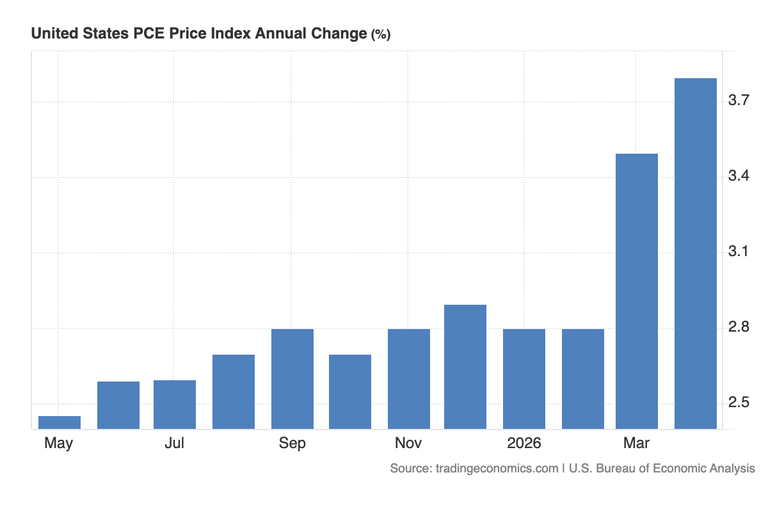
To understand how far we are from the target, the FED wants inflation at 2%. We are almost double that.
“So where is this increase coming from?” you’re probably wondering. Mainly from fuel. Goods prices surged by 0.7% in just one month, with gasoline jumping 5.5%. And the war in the Middle East has exploded energy prices. Brent crude remains 30% higher than where it was before the war began.
But there’s another even more worrying piece. Americans’ personal income remained at zero. Literally 0% growth. And disposable income, meaning what remains after taxes, fell by 0.5%. That’s the third consecutive monthly decline. Despite that, Americans kept spending, with expenditures rising 0.5%. And do you know how they financed that? Through their savings. The savings rate collapsed to 2.6%. The lowest level in four years. One year ago, it was at 5.5%.
That means that within twelve months, Americans have nearly cut in half what they put aside.
CORE PCE
And now we move to the most important part. The Core PCE. What exactly is that? Put simply, it’s the same inflation index, but excluding food and energy. In other words, without the most volatile categories that constantly swing up and down. This is the number the FED watches most closely to understand the real trend of inflation.
And here we got a small sense of relief. Core PCE came in at 0.2% month over month, slightly below the consensus expectation of 0.3%. On an annual basis, however, we are at 3.3%, slightly higher than March’s 3.2%.

So monthly, better. Yearly, worse. A mixed picture.
And this is where things get even more interesting. Omair Sharif from Inflation Insights specifically said that he “would not take much comfort” from this number. Because the decline is probably temporary. The next month will likely be tougher, as the impact from the energy shock will spread with a delay into the rest of the economy.
And here’s something else that few people know. Software and computer accessories jumped 5% in April. Yes, you read that correctly. Five percent in one month. And that’s because of the massive demand for data centers, which is driving prices higher. According to a study by former FED Governor Stephen Miran, the contribution of this category to inflation from November through March was “unprecedented.”
WHAT THIS MEANS FOR THE FED AND INTEREST RATES
And this is where the most critical question comes in. What will the FED do now?
Right now, the market believes the FED will stay on hold at least until the end of 2026. And pay close attention to something very important. Investors are no longer expecting interest rate cuts. They are expecting a possible rate hike at the beginning of next year.
Yes. A HIKE. Not a cut.
And how did we get here?
you’re probably wondering. The truth is that the war with Iran, together with tariffs, has completely derailed the FED’s plan. Just a few months ago, inflation was slowly moving closer to the 2% target, and now it’s accelerating again.
And there’s another dimension here that we shouldn’t overlook. On May 22, the new FED chairman, Kevin Warsh, was sworn in. Appointed by Trump. And Warsh wants lower interest rates. However, he will face serious resistance within his own committee. Because some officials, such as Lisa Cook, have already publicly stated that they are ready to vote for interest rate hikes if inflation persists.
So we now have a new chairman who wants cuts, and a committee thinking about hikes. Just imagine the FED meetings over the coming months. It’s going to be chaos.
This post has been shared on Reddit by @davideownzall through the HivePosh initiative.
It is back quite aggressively. I wonder if there is any real possibility for interest rate increase, I don't see it imo.
If inflation remains under 5%, then I don’t believe that they will increase the rates, but if we see two months over 5%, then I believe they will do an increase of 0.25%.
I believe that nothing favors crypto right now. Inflation wars, supply chain disruptions, monetary policy, geopolitical tensions— everything is against us for now.