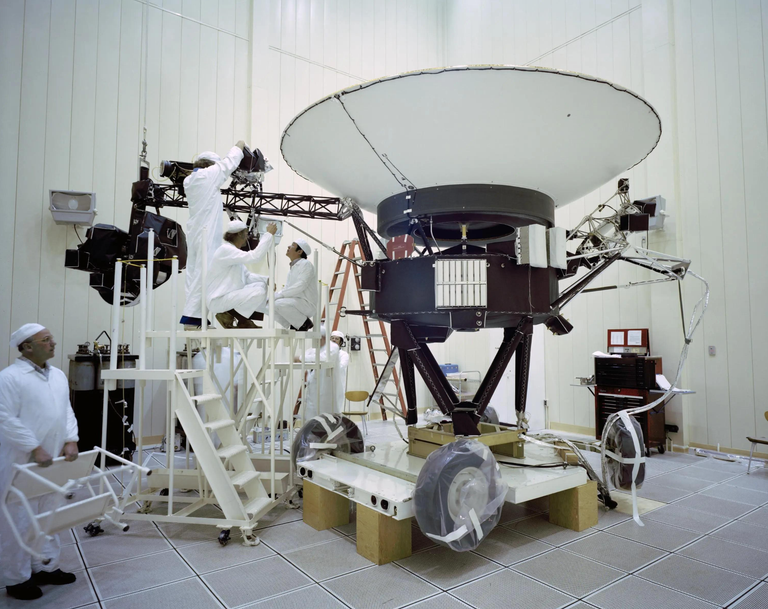
In March of 1977, engineers at JPL were busy preparing Voyager 2 to be launched by NASA in August, 1977. This spacecraft will carry out scientific missions by carrying 10 different instruments; however, over the years, some have been turned off to conserve power. Image Credit: NASA
In the last few years, I have been very interested in the history of space travel from the first missions to the present time. I have also been impressed with how far both Voyager spacecraft have travelled over time and how long they continue to operate. Like Voyager 1, Voyager 2 is just as remarkable. It was launched in 1977 and was originally designed to fly by Jupiter and Saturn, but it ended up being the only spacecraft to fly by all four of the outer giant planets! Here's what it did:
It discovered a 14th moon of Jupiter and studied its extremely complex atmospheric system.
It also defined the unusual structure of Saturn's A ring and its ring spokes.
It discovered 10 new moons and two rings of Uranus, in addition to finding that its magnetic field tilted.
It also found six new moons of Neptune, imaged Neptune's Great Dark Spot, and imaged geysers erupting on Triton.
Voyager 2 continued to journey farther out from the planets after completing its flybys of the four outer planets and crossed the heliosphere into interstellar space on November 5, 2018. It is the second human-made object to leave the heliosphere, after Voyager 1. Even decades after its launch, it continues to send data back to Earth via NASA's Deep Space Network while it travels through interstellar space, and it continues to collect important scientific data, including measurements of plasma waves, magnetic fields, and particle densities in an area of space that has never been explored before.
Currently, it is so far from the Earth that it takes over 18 hours for a signal transmitted to reach the Earth. The power for Voyager 2's instruments comes from plutonium-based radioisotope thermoelectric generators, which are slowly being turned off to conserve power. Some of Voyager 2's instruments are anticipated to continue to function through the 2030s.
It is impressive how Voyager has maintained this incredible longevity; it was designed to operate in the deep space environment, using engineering technology that is simple and highly reliable and it sounds really intriguing knowing that there's also a Voyager Golden Record on board, which is a copper phonograph record that contains sounds and images of Earth and is also on Voyager 2 to serve as a time capsule (or message to the universe) from humanity.
Reference:
NASA. (n.d.). Voyager 2 mission overview
~~~ embed:AllThatsInteresting/comments/1u1t9zk/voyager_2_the_only_spacecraft_to_visit_all_four/ reddit metadata:fEFsbFRoYXRzSW50ZXJlc3Rpbmd8aHR0cHM6Ly93d3cucmVkZGl0LmNvbS9yL0FsbFRoYXRzSW50ZXJlc3RpbmcvY29tbWVudHMvMXUxdDl6ay92b3lhZ2VyXzJfdGhlX29ubHlfc3BhY2VjcmFmdF90b192aXNpdF9hbGxfZm91ci98 ~~~
This post has been shared on Reddit by @theworldaroundme, @davideownzall through the HivePosh initiative.
Technology is advancing day by day and making our lives easier, and it is a fact that a lot of time and effort has been put into bringing technology to life.
That is true, but Voyager is decades old, simply engineered, and has lasted far beyond expectations. People designed it to do only what was necessary for its mission. Nowadays, some designs include many unnecessary extra features and are overly embellished, which can sometimes cause issues.
I have followed the progress of Voyager over the years. Back then it would be photos in National Geographic as we were not online back then. It is an amazing piece of engineering that has lasted longer than you might expect. NASA has a great record for that with their Mars rovers going on for years too. Humans always want to explore.
Aww, haha, it sounds more exciting this way, no wonder that Voyager feels personal to those who followed the news back then.
Yup, we are always curious but never satisfied and look for more, lol. But that is how we learn and discover many things. Some are more inquisitive than others, funny humans.
I'm really impressed about one thing, the fact that signals are still reaching Earth after so long out there
Me too :)
Congratulations @theworldaroundme! You have completed the following achievement on the Hive blockchain And have been rewarded with New badge(s)
Your next payout target is 13000 HP.
The unit is Hive Power equivalent because post and comment rewards can be split into HP and HBD
You can view your badges on your board and compare yourself to others in the Ranking
If you no longer want to receive notifications, reply to this comment with the word
STOP