Duty cycle
Source: https://en.wikipedia.org/wiki/Duty_cycle
As a ratio, duty cycle is unitless and may be given as decimal fraction and percentage alike.
An alternative term in use is duty factor.[7][8][9]
Electrical and electronics[edit]
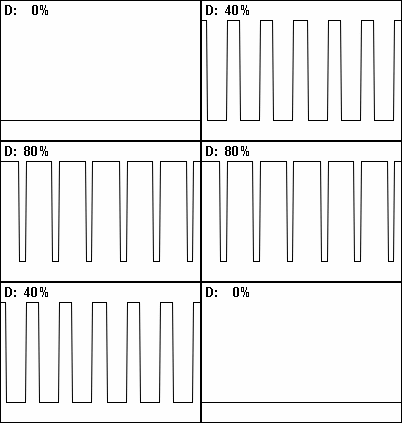
In electronics, duty cycle is the percentage of the ratio of pulse duration, or pulse width (PW) to the total period (T) of the waveform. It is generally used to represent time duration of a pulse when it is high (1). In digital electronics, signals are used in rectangular waveform which are represented by logic 1 and logic 0. Logic 1 stands for presence of an electric pulse and 0 for absence of an electric pulse. For example, a signal (10101010) has 50% duty cycle, because the pulse remains high for 1/2 of the period and low for 1/2 of the period. Similarly, for pulse (10001000) the duty cycle will be 25% because the pulse remains high only for 1/4 of the period and remains low for 3/4 of the period. In power applications (such as motors and actuators), the duty cycle is often defined by the component's ability to dissipate heat; exceeding the rated duty cycle allows thermal energy to accumulate faster than it can be released, potentially leading to insulation failure or component burnout.
Electric motors typically use a duty cycle of less than 100%. For example, if a motor runs for one out of 100 seconds (or 1/100 of the time), its duty cycle is 1/100, or 1%.[10]
Pulse-width modulation (PWM) is used in a variety of electronic situations, such as power delivery and voltage regulation.
In electronic music, music synthesizers vary the duty cycle of their audio-frequency oscillators to obtain a subtle effect on the tone colors. This technique is known as pulse-width modulation.
In the printer / copier industry, the duty cycle specification refers to the rated throughput (that is, printed pages) of a device per month.
In a welding power supply, the maximum duty cycle is defined as the percentage of time in a 10-minute period that it can be operated continuously before overheating.[11]
Power electronic converters use the duty cycle to control output voltage and current. In a buck converter, the average output voltage goes up and down with the duty cycle pretty much in lockstep. But with boost converters, things get less straightforward—the relationship isn’t linear. The duty cycle also impacts switching losses, current ripple, and overall efficiency, so nailing down tight control over it is a big deal in today’s DC-DC converters and motor drives.[12]

The concept of duty cycles is also used to describe the activity of neurons and muscle fibers. In neural circuits for example, a duty cycle specifically refers to the proportion of a cycle period in which a neuron remains active.[5]

One way to generate fairly accurate square wave signals with 1/n duty factor, where n is an integer, is to vary the duty cycle until the nth-harmonic is significantly suppressed. For audio-band signals, this can even be done "by ear"; for example, a −40 dB reduction in the 3rd harmonic corresponds to setting the duty factor to 1/3 with a precision of 1% and −60 dB reduction corresponds to a precision of 0.1%.[13]

Mark–space ratio, or mark-to-space ratio, is another term for the same concept, to describe the temporal relationship between two alternating periods of a waveform. However, whereas the duty cycle relates the duration of one period to the duration of the entire cycle, the mark–space ratio relates the durations of the two individual periods:[14]

where and are the durations of the two alternating periods.

^ Barrett, Steven Frank; Pack, Daniel J. (2006). "Timing subsystem". Microcontrollers Fundamentals for Engineers and Scientists. Morgan and Claypool Publishers. pp. 51–64. ISBN 1-598-29058-4.
^ Jump up to: a b Cox, James F.; Chartrand, Leo (June 26, 2001). "Nonsinusoidal oscillators". Fundamentals of Linear Electronics: Integrated and Discrete (2 ed.). Cengage Learning. pp. 511–584. ISBN 0-766-83018-7.
^ "Definition: duty cycle". Federal Standard 1037C, "Telecommunications: Glossary of Telecommunication Terms". Boulder, Colorado: Institute for Telecommunication Sciences. 1996. Retrieved March 3, 2011.
^ Brown, Martin (1990). "How a switching power supply works". Practical Switching Power Supply Design (Motorola Series in Solid State Electronics). San Diego, CA: Academic Press. pp. 5–8. ISBN 0-121-37030-5.

^ Jump up to: a b Harris-Warrick, Ronald; Nagy, Frédéric; Nusbaum, Michael (1992). Harris-Warrick, Ronald; Marder, Eve; Silverston, Alan; et al. (eds.). Dynamic biological networks: the stomatogastric nervous system. Massachusetts: MIT Press. pp. 87–139. ISBN 0-262-08214-4.
^ Singh, M. D. (2008-07-07). Power Electronics. Tata McGraw-Hill Education. ISBN 9780070583894.
^ Rudolf F. Graf (1999). Modern Dictionary of Electronics. Elsevier Science. p. 225. ISBN 978-0-08-051198-6.
^ "EN 60469:2013". standards.cencenelec.eu. Retrieved 2023-10-14.
^ "IEC 60469:2013". webstore.iec.ch. Retrieved 2023-10-14.
^ "Electric Motors". Machine Design. Retrieved March 23, 2011.
^ "What does the term duty cycle mean?". ZENA, Inc. welding systems. Retrieved March 23, 2011.
^ Erickson, Robert W.; Maksimović, Dragan (2004). Fundamentals of Power Electronics (Second ed.). Boston, MA: Kluwer Academic Publishers. ISBN 978-0-306-48048-5.
^ William M. Hartmann (1997). Signals, Sound, and Sensation. Springer Science & Business Media. p. 109. ISBN 978-1-56396-283-7.
^ "555 Timer Astable Circuit". Retrieved September 19, 2020.
🔐 Cryptographic Verification
Archived URL: https://en.wikipedia.org/wiki/Duty_cycle
📄 CONTENT HASHES:
  SHA-256:  474102a4a3a36970ce99bb150c6134d9fa1d91410f76e6871f63098ea1487011
  BLAKE2b:  27203af6aeee7cea5c50b648032b38e145ec372d0a62ec6ca184a005fa0b7e1d
  MD5:      613b367aeafc0a8cd26f2de45d688966

📝 TITLE HASHES:
  SHA-256:  fc43f8eb6addd686c09eea43a93a4d0fe77f00e142dae828fa6c7be97a01a799
  BLAKE2b:  c98c3196d7e9d9d5ea5036bd501a494dee01be9ac36893010714d4a19aaa4023
  MD5:      e1bd735e1f07f2e706e9d8c5310121bb

🔒 INTEGRITY HASHES:
  SHA-256:  9959599c93d49874977f0dedb5c5f2a8fe039f9755efad5e3b4649e157632a32
  BLAKE2b:  94753f1aafb2239def51ac3d83d8b5fb1a2dc733a70977c88899a63a356856c8
  MD5:      f4b835fd3407dbceb755f9e2ac7327ff
Archived with ArcHive - Client-side cryptographic archival system