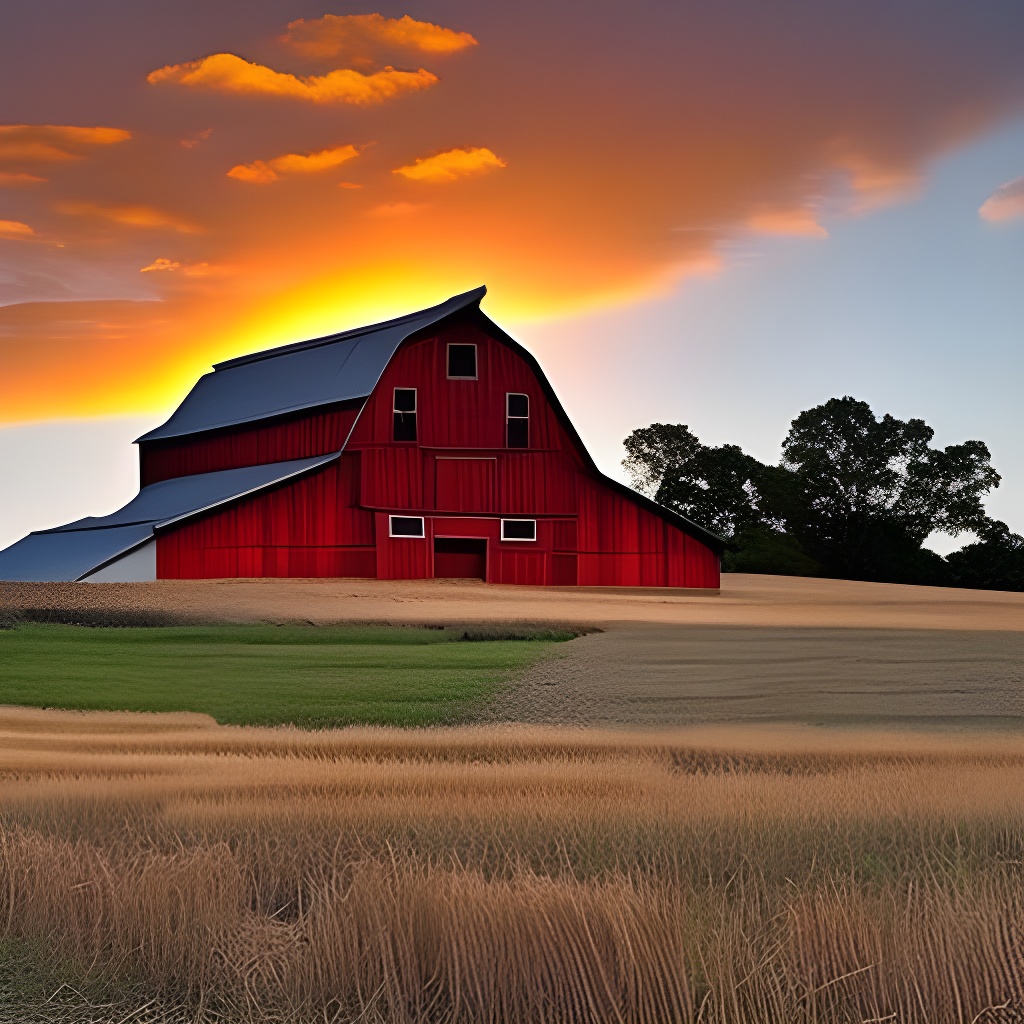
The above image was made with stable diffusion using the prompt 'A traditional barn raising sunset.'
Recently I wrote about the apocalypse bunkers of the rich, suggesting that their money might be better spent investing in agricultural and manufacturing communes. Today, just for fun, I started thinking about the specifics of what that might look like. Specifically, I considered what a project balancing environmental impact with apocalypse protection might involve. For the purposes of this exercise, I assumed that an entire square mile of rural property could be purchased and vacated, which isn't a reasonable assumption.
Cost
There are 640 acres in a square mile. In the state of Michigan, the average cost of agricultural land in 2022 was $5,850 per acre. So the purchase of a square mile of land in this state would cost about $3,744,000. Property tax there runs about 1.32%, or about $49,421 annually. Because Michigan is cannabis-friendly, cannabis and hemp production could easily offset this ongoing expense.
It's fair to assume that any square mile of land would contain many structures, like houses and outbuildings. There might even be commercial buildings, if the property were bounded on a side by a main road. The land would also likely be divided by at least one and maybe several smaller roads. There would be costs associated with demolition or renovation of older buildings. There would be a cost to install wildlife crossings and other environmental infrastructure. There could also be utility infrastructure that needed updating. That sounds like another $3 million to me.
As for the high net worth individual's actual bunker, $2 million would cover a well-appointed shelter for vacations and emergencies. All of that brings us to almost $9, so with legal fees and other misc costs, the project might have an upfront cost of $10 million. I'm sure there are HNWI's paying far more for their luxury bunkers.
Community
There are a million ways our HNWI could establish community on their property. Assuming 60% conservation and 20% agricultural/industrial/commercial, there would still be a fair amount of space for people to live. Presumably, some people would work on the property while others would work in nearby towns. There may also be a sizable population of transient workers depending on the farming taking place. This sounds to me like 40 homesteading families with a worker population of 20-100.
But community is more than people living and working near each other. If our HNWI is interested in the kind of community that'll insulate against hardship in the event of system disruption, they'll need to take steps to bring people together, and to create governance structures that work for everyone. While the whole arrangement would essentially be feudal, there's no reason the community couldn't rely on participatory democracy for everyday affairs.
One thought I had was to divide the property into four quadrants, with reds in one, blues in another, artists in a third, and technologists in a fourth. Members of each quadrant could decide for themselves how to govern hyperlocal matters. For issues concerning the broader community, each quadrant would select a representative, and the four representatives plus the HNWI would comprise the endeavor's board of directors.
There would probably need to be at least one place for everyone to just get together and hang out. And each quadrant might have its own idea of a community center. Maybe a church in the red zone, a library in the blue zone, a coffeehouse in the artist zone, and a bar for the technologists. In addition to these places, a general community center for public meetings would make sense.
If our HNWI wants to attract homesteaders, the way to do it is to make them part of a compelling story. Environmental conservation may be a piece of this story. So might economic incentives. But ultimately, it's shared rituals and common purpose that bring people together. Hopefully, our HNWI will be aware of this before spending millions on such an endeavor.
Read my novels:
- Small Gods of Time Travel is available as a web book on IPFS and as a 41 piece Tezos NFT collection on Objkt.
- The Paradise Anomaly is available in print via Blurb and for Kindle on Amazon.
- Psychic Avalanche is available in print via Blurb and for Kindle on Amazon.
- One Man Embassy is available in print via Blurb and for Kindle on Amazon.
- Flying Saucer Shenanigans is available in print via Blurb and for Kindle on Amazon.
- Rainbow Lullaby is available in print via Blurb and for Kindle on Amazon.
- The Ostermann Method is available in print via Blurb and for Kindle on Amazon.
- Blue Dragon Mississippi is available in print via Blurb and for Kindle on Amazon.
See my NFTs:
- Small Gods of Time Travel is a 41 piece Tezos NFT collection on Objkt that goes with my book by the same name.
- History and the Machine is a 20 piece Tezos NFT collection on Objkt based on my series of oil paintings of interesting people from history.
- Artifacts of Mind Control is a 15 piece Tezos NFT collection on Objkt based on declassified CIA documents from the MKULTRA program.
I like the thinking behind all of this! If I were to participate in something like this, I would definitely be on the committee of social events and gatherings. Like planning big community events for all to participate in across quadrants, conflict mediation work, creative projects, etc :)
I like how you often include sunsets in your ai prompts :)
I'm thinking about using this as a setting for a scifi story: )
Yes, sunset jazzes up the images. I probably use it too much, but oh well.
Can't wait to read what you create from this!
The rewards earned on this comment will go directly to the people sharing the post on Twitter as long as they are registered with @poshtoken. Sign up at https://hiveposh.com.