[OC] Excel
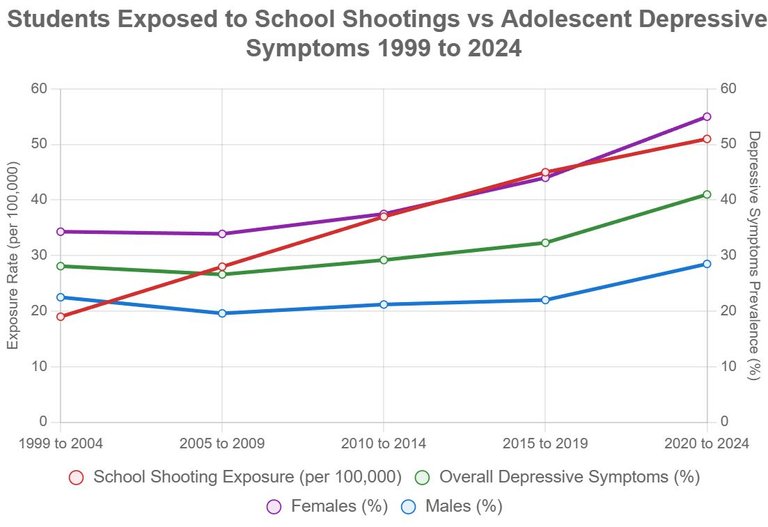
It clearly shows the rise in both exposure to school shootings and teen depression over time, which shows the potential connection between school safety and mental health.
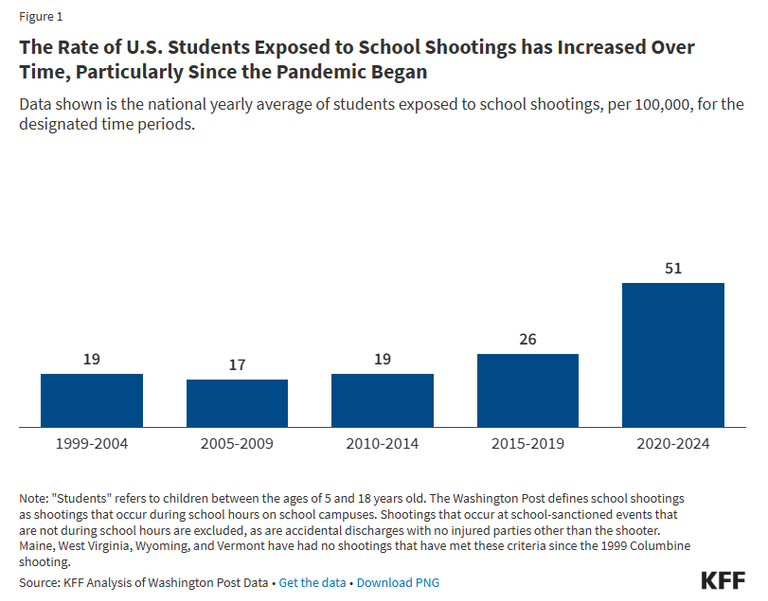
According to the Kaiser Family Foundation (KFF, 2025), the number of U.S. students attending schools affected by shootings has increased significantly over time. From 1999 to 2004, about 19 out of every 100,000 students went to a school where a shooting happened. In 2020 to 2024, that number rose to about 51 out of 100,000, almost three times higher.
Some places, like Delaware, Washington D.C., Utah, Arkansas, and Nevada, have especially high numbers.
“Exposure” means that a shooting happened at a student’s school during the year, even if they didn’t see it or get hurt. But even this can seriously affect mental health, causing anxiety, trouble focusing, skipping school, signs of trauma, and a higher risk of suicide.
Schools implement measures such as drills, metal detectors, and resource officers to keep students safe, but some of these interventions may unintentionally add stress.
The report says that school shootings affect many more students than just the ones directly involved. To help protect students’ well-being, schools need strong mental health support and safety policies that don’t unintentionally cause more harm.
Depression among teenagers has also been rising over the same period. The following table shows both the exposure to school shootings and the prevalence of depression among adolescents, with differences for girls and boys.
Year Period | Exposure Rate (per 100,000) | Overall Symptoms (%) | Females (%) | Males (%) |
|---|---|---|---|---|
1999-2004 | 19 | 28.1 | 34.3 | 22.5 |
2005-2009 | 28 | 26.6 | 33.9 | 19.6 |
2010-2014 | 37 | 29.2 | 37.5 | 21.2 |
2015-2019 | 45 | 32.3 | 44.0 | 22.0 |
2020-2024 | 51 | 41.0 | 55.0 | 28.5 |
Data on student exposure to school shootings comes from the Kaiser Family Foundation (KFF, 2025). Information about adolescent depression was informed by the CDC (2023) and NCBI (2023). These sources do not provide detailed depression data for each year in the table; therefore, depression values were collated by the author for illustrative comparison only.
References:
CDC. (2024a). YRBS Data Summary & Trends Report: 2013–2023. https://www.cdc.gov/yrbs/dstr/pdf/YRBS-2023-Data-Summary-Trend-Report.pdf CDC. (2024b). Youth Risk Behaviour Surveillance, United States, 2023. MMWR, 73(Suppl-4). https://www.cdc.gov/mmwr/volumes/73/su/pdfs/su7304-H.pdf KFF. (2025). Examining school shootings at the national and state level. https://www.kff.org/mental-health/examining-school-shootings-at-the-national-and-state-level-and-mental-health-implications/
© 2025 Mariah (OC)
This post has been shared on Reddit by @theworldaroundme through the HivePosh initiative.