The Conclusion

Time To Clean Up The City
By early March 1942 the Leningrad authorities were acutely aware that the city was full of unburied corpses, filth and debris from fires and the German shelling of the city. The city leadership realised that unless there was big clean up, to remove corpses, filth and debris, there was a danger of various epidemics breaking out and getting out of control. Such epidemics would have the potential to kill large numbers of people especially considering that the population was severely undernourished with scurvy being rampant amongst the populace.
To compound matters the people themselves were as filthy as the homes they lived in. Many of the cafeterias and food halls were large numbers of citizens were fed were scummy, unwashed and revolting.
The very high sickness rate of workers in the cities factories gave the authorities great cause for concern. At the Kirov metallurgical works out of 10,424 workers only 2,416 reported for work in February 1942. Even more troubling were the outbreaks of typhus and typhoid. To make matters worse the city was suffering from a dysentery epidemic. Leningrad’s sewage had broken down in January 1942 and people had resorted to flinging human waste out into the streets.
The onset of March saw the combination of dysentery and starvation lead to the death rate rising rapidly. Michael Jones, in his account of the siege, quotes one Soviet source who estimated that during early March 20-25,000 people were dying each day from the dysentery epidemic. Jones notes that this epidemic pushed many people over the edge:
The dysentery epidemic accelerated the death rate, and also represented a psychological tipping point, when the people, already stretched to the limits of human endurance, were simply unable to take any more. Once again, there was a surge of cannibalism within the city.
Clean up brigades were organised involving the Young Communist organisation and tens of thousands of woman. International Women’s Day on 8 March was chosen as the day to launch the clean up. This slow start to the clean up began to pick up on 15 March when over 100,000 responded to the call of the City Council to clean up the streets and apartment blocks. Elena Martilla wrote at the time, “We had declared war on dirt, and through this declaration, the isolated and inactive regained a sense of purpose.”
The call to hard manual labour posed an immense challenge for the population as Dmitry Likhachev pointed out, “Most of the city’s inhabitants had begun to clean the streets and clear the refuse with bodies so weakened thy could barely grip a spade, let alone wield it.”

Kyra Pterovskaya later remembered:
We had to liberate our streets from millions of cubic feet of frozen dirt and refuse. All around me were women and children. They moved slowly for they were malnourished and weak – and I couldn’t visualise how the city could be cleaned by such an enfeebled workforce. But then there is strength in numbers. There were tens of thousands of people like us, chopping, digging, scrapping, clearing tiny patches in the overall chaos of snow and ice.
The scale of the problem facing the city wide clean up is illustrated by a scathing declaration made by the Leningrad party leadership on 26 March 1942:
Up to now the clean up campaign has been completely unsatisfactory. The snow and the dirt have been removed from less than half of the city’s houses. Some streets are still impassable to pedestrian and vehicle traffic because of heaps of piled up ice. Hundreds of neglected garbage pits have become a real source of infection…
The people of Leningrad did not need to be berated by the pampered city authorities to understand the urgency of the situation. By 31 March over 304,000 people had joined the daily clean up. By 15 April over 12,000 courtyards had been cleaned, 3 million square feet of streets were cleared and one million tons of filth had been removed along with tens of thousands of corpses which had been buried.
The Leningrad poet Nikolai Tikhonov remarked on this remarkable achievement when he wrote, “It was a stupendous feat, performed by people worn down by months of starvation. The Augean Stables were child’s play in comparison.”
The city clean up lifted the morale of the battered population which marked a turning point in the city’s survival. Elena Martilla regarded this collective effort by the entire population to be an act which imparted a renewed determination to survive the horrors of the siege:
As they worked, people passed on their collective strength to each other. And through this strength came an affirmation of our common cause. We would defy Hitler’s cruel order that our city should be erased from the earth. It would stay habitable. We were proud to be called Leningraders.
Besides the clean up the Leningrad authorities took a variety of measures to improve public health and start to bring the city back to life. Eight factories were put to work producing vitamin C from pine needles and over 16 million doses were produced to address the scurvy which was rampant amongst the population. Mass vaccination campaigns were started to prevent the further spread of typhus, typhoid and plague. During March 1942 twenty five public baths reopened as did a hundred laundries.
The postal system restarted and the trams started running again. In many people’s eyes just as important was the relaunch of the city’s cultural life. The Musical Comedy Theatre was working again and the first music concert was given in early April in the Pushkin Drama Theatre.

Despite all of these very positive developments which saved many lives the death rate continued to rise with April 1942 probably seeing the highest mortality rate of the entire siege at over 102,000 dead for the month. April saw the Luftwaffe resume its bombing raids over the city. It should be noted that the German artillery bombardment of the city never stopped through out the winter of 1941-42, it continued like clockwork leaving death and destruction in its wake.
By the end of April the population of Leningrad, through a combination of mass evacuations and famine, had been reduced to 1.1 million from a pre war population of 2.5 million.
Leningrad comes back to life during the summer of 1942
The end of spring and the onset of summer raised the hopes of many Leningraders that the siege might be lifted during 1942. Sadly, this was not to be the case.
The summer of 1942 saw the Red Army become engaged in a deadly struggle with Army Group South in Southern Russia which culminated in the bloodbath that was the Battle of Stalingrad. In front of Moscow Marshall Zhukov launched an attack on Army Group Centre which failed yet it imposed heavy casualties on the Germans and prevented any reinforcements being sent to the southern front.
Leningrad received a new military commander Lieutenant General Leonid Govorov who was an artilleryman. His first action on resuming command of the Leningrad garrison was to improve the counter battery fire of the city’s big guns. The heavy guns of the German Eighteenth Army continued to pound the city every day.
Govorov brought into the city two air observation units with the purpose of enabling Leningrad’s guns to seek out and destroy German artillery positions. Shell production in the city was increased as were ammunition supplies from outside.
Govorov also made the decision to end the tragedy that was the Neva bridgehead which had lasted for seven months and cost the lives of tens of thousands of Red Army men. He came to the conclusion very quickly that this bridgehead was nothing but a ‘bloodbath’ and the 86th Infantry Division was transferred to the right bank of the Neva.
In July 1942 Stalin and his senior generals made the decision to transform Leningrad into a ‘military city’. This meant that only the minimum population necessary to carry out the defence of the city was to remain. Another mass evacuation was ordered. Another 300,00 people were to be evacuated across Lake Ladoga bringing the population of Leningrad to 800,000.

During the summer of 1942 there were indications that the Nazis were going to make another attempt to conquer the city. Hitler issued directive No.45 which instructed Army Group North and the German Eighteenth Army to start preparations for an assault on the city in September. Reinforcements and fresh deliveries of ammunition were sent to the Eighteenth Army.
During the spring and summer of 1942 grassed areas disappeared all over the city to be replaced by vegetable gardens. On the Champs de Mars cabbage and potato gardens grew between the anti-aircraft guns. The citizens of the city were encouraged to eat wild plants such as nettles, sorrel, dandelions and burdock. Lists of edible wild plants were posted on the side of buildings across the city.
As people waited for the time to harvest their vegetable gardens they ate different kinds of grass often making porridge out of the grasses. In his diary Igor Chaiko observed;
Grass, grass, grass. The whole city is eating different kinds of grass. At the garden fences children are calling out to each other hauling grass through the rails, eating it as if they were rabbits.
The revival of the performing arts during the summer of 1942 lifted the morale of the people. Michael Jones has noted that, “culture became a lifeline. It deeply touched people and by doing so it became a powerful source of affirmation.”
Painting exhibitions, the opera, musical concerts all were attended by large numbers of people. The pianist Maria Yudina said, “There was a powerful energy flowing between the artist and audience in the besieged city one that allowed them to rise above the day to day horror they all faced.” Alexandra Ivanovna, who had seen all her family die during the winter, conducted a choir to entertain Red Army soldiers. She later recalled, “It meant far more to us than just singing. It was the victory of the human spirit.”

A highlight of the summer 1942 was the first performance in Leningrad of Shostakovitch's Seventh ‘Leningrad’ Symphony. Coming only a few days after the fall of Sevastopol the performance of the Seventh Symphony roused the fighting spirit of the population. Tamara Korolkevich remembers buying tickets for the concert; “The event was unmissable. The music had been dedicated to us, and to our city. Can you imagine the power of that?”
On the evening of 9 August 1942 the Philharmonic Hall was packed with people of all classes. The entire city was glued to radio transmitter dishes waiting for the broadcast of the symphony to begin. Even Red Army men in the trenches were listening and waiting for this momentous event to begin. One member of the orchestra who performed that night was Mikhail Parfionov who recalls;
We were stunned by the number that had turned out … And we realised that these people were not just starving for food, but starving for music. We resolved to play the very best we could.
At 6pm on 9 August orchestral conductor Karl Eliasburg, who was to conduct the Leningrad Symphony that evening, spoke on the radio and addressed the people of the city:
Comrades – a great event in the cultural history of our city is about to take place. In a few minutes, you will hear for the first time the Seventh Symphony of our fellow citizen Dmitri Shostakovich. He began his great composition in Leningrad, when the enemy – insane with hatred – first tried to break into our city. When the fascist swine were bombing and shelling us everyone believed that the days of Leningrad were over. But this performance is proof of our spirit, courage, and readiness to resist!
Towards the end of the symphony several members of the orchestra faltered due to exhaustion and the entire audience rose to its feet encouraging them to go on. The end of the symphony was initially met with silence and then terrific applause. Many were reduced to floods of tears in this emotionally charged situation.
The composer Karl Eliasberg later recalled:
People just stood and cried. They knew that this was not a passing episode but the beginning of something. We heard it in the music. The concert hall, the people in their apartments, the soldiers on the front – the whole city had found its humanity. And in that moment, we triumphed over the soulless Nazi war machine.
The restoration of the land link to Leningrad - January/February 1943
On 11 January 1943 the Red Army launched an offensive ‘Operation Spark’ which broke through the German front lines south of Lake Ladoga and created a land bridge which was eleven kilometres wide and thirty three kilometres long. General Govorov’s offensive started with a 4,500 gun bombardment of the German front lines. Savage fighting lasted for a week. On 18 January the German Eighteenth Army withdrew its infantry back towards the Siniavino Heights.
Well before this offensive the Red Army had set to work building a railway which would connect Leningrad with the rest of the Soviet Union. In February 1943 the so called ‘Road of Victory’ more commonly known to many at the time as the ‘Road of Death’ was completed. The railway greatly increased supplies for the besieged city.

The construction of this railway was a remarkable achievement for it had to traverse very boggy, rugged terrain which included frozen swamps and streams. It was visible to German artillery spotters in the Sinyavinskiye Heights. It was under constant German fire. The work went on day and night under terrible weather conditions. Every day dozens of workers died during the construction of the railway.
Besides this, a bridge was constructed so that the railway could span part of the Narva river. It was under constant attack and had to be continually repaired while under construction.
The first food train from the mainland arrived in Leningrad on 7 February 1943. The railway dramatically increased the food supplies coming into the city. It delivered far more food than the route across Lake Ladoga. Over the course of the next year leading up to the lifting of the blockade on 27 January 1944 the railway line accounted for over 75% of all food brought into the city. 4,729 trains travelled across this railroad into Leningrad. It should be noted that trains ran the other way as armaments produced in Leningrad’s factories were shipped out to be used on other fronts across the Soviet Union.

The Nazis never gave this railroad a moments peace. Fifteen hundred trains were destroyed by German artillery fire killing over two hundred rail workers. We should also not forget the many hundreds of builders and soldiers who died during the construction of this remarkable railway. After the lifting of the siege the railway ceased to be used. It had played a critical role in saving the lives of large numbers of malnourished people in Leningrad.
Olga Berggolts summed up the common perception amongst the people of Leningrad that this was a victory for the people of the city:
We have waited along time for this day. Yet we always believed it would come. We hoped for it during Leningrad’s blackest months – January and February of last year. We hoped for it when our friends and relatives died, and we ourselves, turned to stone by sorrow, buried them in the frozen ground, in mass communal graves, lacking even the strength to relieve our hearts with tears. We will be victorious!
Despite this victory Leningrad remained under siege. The Germans retained the majority of their positions around the city and kept up their daily artillery barrage of the city for the next year. The German defensive line was named ‘The Northern Rampart’ and was over a hundred miles long and four miles deep. Exhausted after ‘Operation Spark’ the Red Army was in no position to attempt an assault on this formidable barrier. It took decisive victories on other fronts such as the defeat of the Army Group South at the Battle of Kursk in July 1943 to prepare the ground for the final offensive to lift the siege of Leningrad.
Lifting of the Siege 27 January 1944
January 27 has become established on the historical calendar as the liberation of the infamous death camp at Auschwitz in 1945 by the Red Army. Yet this overlooks an equally historic moment when the Red Army lifted the siege of Leningrad a year earlier on 27 January 1944.
By early December 1943 the Nazis had been driven from most of central and eastern Ukraine. Stalin and his senior generals unleashed a third winter offensive in December 1943 which was designed to clear German forces completely from Ukraine, from Belorussia, the Crimea and from the approaches to Leningrad thus lifting the siege of the city.
This plan entailed a series of staggered offensives lasting from December 1943 to spring 1944. The Red Army fielded over 6 million men under arms compared to the Wehrmacht and its allies which could only muster 2.4 million soldiers who were heavily outgunned by their Soviet counterparts. From December 1943 to February 1944 the Red Army launched five separate offensives. By the end of February the Nazis forces had lost their defensive positions along the entire line of the Dnepr river. The Red Army was now poised to clear the German armies from the interior plains of Ukraine and the Crimea. By May 1944 the German invaders had suffered devastating defeats and had been removed from nearly all Soviet territory in the south. Four German armies had suffered a severe mauling and taken very heavy casualties.
As the Red Army was liberating Soviet territory in the south it was able to finally remove the German presence from the region surrounding Leningrad. During January 1944 the Leningrad Front commanded by General Govorov and the Volkov Front commanded by General Meretskov joined forces in launching a multi-pronged attack on the German Eighteenth Army. The Novgorod-Luga Offensive started on 14 January with a surprise attack from the Oranienbuam bridgehead by the 2nd Shock Army. As the Eighteenth Army was focused on this attack the other pincers of the Soviet offensive joined in the fray. On 15 January the Leningrad Front bombarded the German lines with over half a million artillery shells in just over two hours making it the heaviest Soviet barrage of the war.
Over the next two weeks Red Army troops pushed the German Eighteenth Army back from town after town in the outlying areas of the city. They captured the German heavy siege guns which had caused so much death and destruction in Leningrad. On 22 January a Red Army communique stated that its forces were struggling to keep up with the German forces such was the rapid rate of their retreat. Red Army soldier Joseph Pilyushin, who served on the Leningrad Front for the duration of the siege recalls:
So here it was, the long awaited minute! First one, after it another, and then a third green flare soared into the sky. Without a single shout, we rushed towards the German lines. We took the first and second trenches with unprecedented speed. We never stopped; we tore into the depths of the Nazi defences, destroying everything the least bit suspicious in our path.
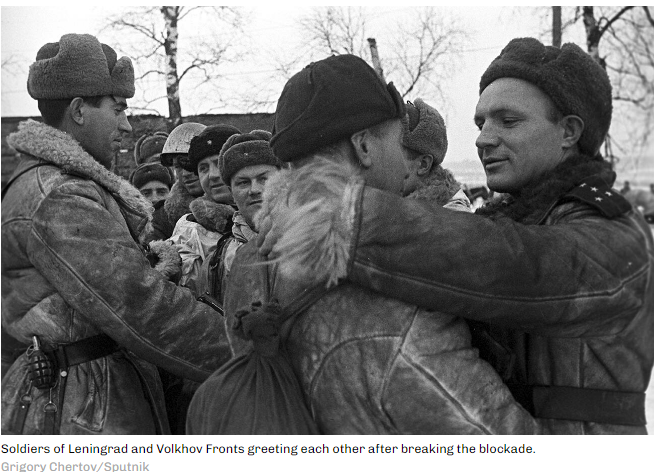
On 27 January 1944 at 8pm General Govorov announced, “The city of Leningrad has been liberated.”
The 872 day siege was over.
Later that evening huge numbers of people turned out on to the Field of Mars where 324 guns fired a twenty four victory salvo. The Baltic Fleet shone its searchlights on the buildings of Leningrad while hundreds of military flares of different colours were fired into the sky.
The end of the siege brought enormous relief that the German bombardment of the city was finally over. The poet Olga Berggolts wrote;
Children can now walk on the sunny side – ‘the most dangerous’ – of the Nevsky Prospect…. And they can live peacefully in rooms that look out on the sunny side. They can even sleep peacefully and soundly at night, knowing that they won’t be killed.
To some people the end of the siege brought a variety of conflicting emotions. Evgenia Shavrova said, “I just can’t comprehend that the siege is over. It is impossible to describe my joy.”
Conclusion
Once the siege was over the Leningrad authorities set about constructing their own version of the siege which emphasised the heroic struggles and sacrifices of the people of the city. Sadly, it downplayed the suffering of the people, the numbers of those who had died and the incompetence and corruption of the city authorities. The historian Michael Jones in his account of the siege makes the following noteworthy point:
It is this aspect of Leningrad’s story which has kept these events from being fully understood by the wider world until now, and which still bewilders and deters Western attempts to integrate Soviet heroism into the narrative of the resistance to Nazism.
During the siege itself and in the years that followed public expressions of grief regarding the terrible suffering of the people were prohibited. Thankfully, the numerous diaries which were kept by hundreds of blokadniki express the grief which was central to most people’s experiences of the siege. The communist poet Olga Berggolts in her memoirs recalls how she read many such diaries:
Singed and icy, the triumphant Leningrad tragedy breathes from the many, many pages of these diaries, where a person writes with total candour about everyday cares, efforts, sorrows and joys. And as a rule, the deeply personal is at the same time more universal, more general. History suddenly speaks with a simple, living human voice.
The destruction which the German siege caused to the city was immense. The Wehrmacht’s bombardment of Leningrad destroyed over 15 million square feet of housing leaving over 700,000 people homeless. The catalogue of destruction includes: 526 schools, 101 museums, 21 scientific institutions, 840 factories, 71 bridges and 187 historical monuments. The total cost of damage to the city was estimated after the war to be over 45 billion roubles.
The number of people who died during the German siege of Leningrad will never be fully known. At the Nuremberg war crimes trials in 1946 the Soviet government submitted the figure of 671,635 deaths caused by the Germans genocidal siege of whom 641,803 died from starvation. Yet we know that the Leningrad authorities and the Kremlin for political reasons downplayed the number of those who died.
In his account of the battle for Leningrad Harrison Salisbury provides a detailed breakdown of the different assessments given for the death toll. He gives the figure of 800,000 dead from starvation within Leningrad itself and another 200,000 civilians died from starvation in the villages and towns surrounding the city. He puts Red Army deaths at a round 500,000. One thing Salisbury asserts with complete confidence is the following, “More people had died in the Leningrad blockade than had ever died in a modern city – anywhere – anytime: …’’
David Glantz, who is one of the most distinguished historians of the Eastern Front, in his book The Siege of Leningrad: 900 Days Of Terror puts the death toll at between 800,000 and one million civilians. He estimates that Red Army deaths to be almost as great as the number of civilians who died from starvation. Glantz asserts that even on the conservative side around 1,017,881 soldiers were killed, captured or missing. He puts the number of wounded at a staggering 2.4 million. This represents 12% of the Red Army’s total casualties of 28.2 million. He makes the following observation on the terrible toll which the Battle for Leningrad took on the Soviet people, a toll which is rarely acknowledged in Western accounts of the resistance to German fascism:
Thus, the number of soldiers and civilians who perished during the Battle for Leningrad amounted to the awesome total of between 1.6 and 2 million souls. These figures associated with the defence of a single city are six times greater than the United States’ total death toll during the entirety of World War 11.
Despite the horrific human suffering during the Battle for Leningrad it did contribute ‘positive’ military outcomes with regard to the development of Soviet military strategy and operational tactics. It was the first place that the German Blitzkrieg was halted in its tracks which as Glantz notes had ‘far-reaching consequences.’ The German Eighteenth Army suffered very heavy casualties in its attack on Leningrad which forced Hitler to change his Barbarossa strategy. The failure of Army Group North to capture the birthplace of Bolshevism by September 1941 and the subsequent attritional fighting during the autumn of that year forced Hitler to reinforce the army group with 16 divisions and two brigades of whom seven divisions came from Army Group Centre. Glantz points out that, “This weakened the main German drive on Moscow, [by Army Group Centre] perhaps fatally.”
The deeply echeloned defences of Leningrad led to the development of ‘new standards of sophistication’ for the defence of a modern city which produced practical experiences which helped with the defence of Stalingrad.

The successful defence of Leningrad from September 1941 to January 1944 against all the odds, when even the Kremlin leadership had fears that the city would fall, had a hugely positive impact on the morale of the Soviet people who were fighting off the German war of annihilation waged against them during this period.
David Glantz has summed up perfectly the importance of the Battle for Leningrad and why Germany’s genocidal siege should never be forgotten:
Although the Battle for Leningrad played a significant role in the war’s ultimate outcome, its role was not militarily decisive. In terms of drama, symbolism and sheer human suffering, however, the Battle for Leningrad has no peer either in the Great Patriotic War or in any other modern war.
Andrei Krukov, who was twelve years old when the siege began, was interviewed by the historian Michael Jones about the ‘spiritual experience’ of surviving the siege. Jones notes how we can never truly understand the horrors of the siege or how people managed to find the will to survive. Krukov told him:
The suffering was on an unimaginable scale – yet, astonishingly, Leningrad did not succumb. People somehow found the strength to reach out and help others, and by doing this, something mysterious yet deeply powerful came into being. We were fighting a battle to keep a human face, to stay human beings. And we won it.
Here lie citizens of Leningrad
Men, women and children
Besides them soldiers of the Red Army
They gave their lives defending you, Leningrad
Cradle of the revolution
Let no one forget, let nothing be forgotten
Inscription on the statue of Mother Russia in the cemetery
where victims of the siege are buried in mass graves

Suggested Reading List
Ales Adamovich and Daniil Granin, Leningrad Under Siege: First-Hand Accounts Of The Ordeal
Lidiya Ginzberg Blockade Diary
David Glantz The Siege of Leningrad 1941-44: 900 Days Of Terror
Michael Jones Leningrad State Of Siege
Joseph Pilyushin Red Sniper On The Eastern Front: The memoirs of Joseph Pilyushin
Jeff Rutherford Combat and Genocide on the Eastern Front 1941-44
Harrison Salibsury The 900 Days: The Siege Of Leningrad
Caroline Walton The Besieged A Story Of Survival
Alexander Werth Leningrad
Interesting story, well told! I'll have to go read the others.
Congratulations @saltycat! You have completed the following achievement on the Hive blockchain And have been rewarded with New badge(s)
Your next target is to reach 450 posts.
You can view your badges on your board and compare yourself to others in the Ranking
If you no longer want to receive notifications, reply to this comment with the word
STOPTo support your work, I also upvoted your post!