Hive has no password reset button. No "forgot my login" email, no support agent who can restore your access, no company that can hand your account back. Read that twice, because it is the least familiar thing about the platform and the source of both its greatest strength and its sharpest edge.
Your account is controlled by cryptographic keys. Hold them and nobody can take the account from you, not a moderator, not a corporation, not Ecency. Lose them and nobody can give it back. Everything in this post follows from that trade.
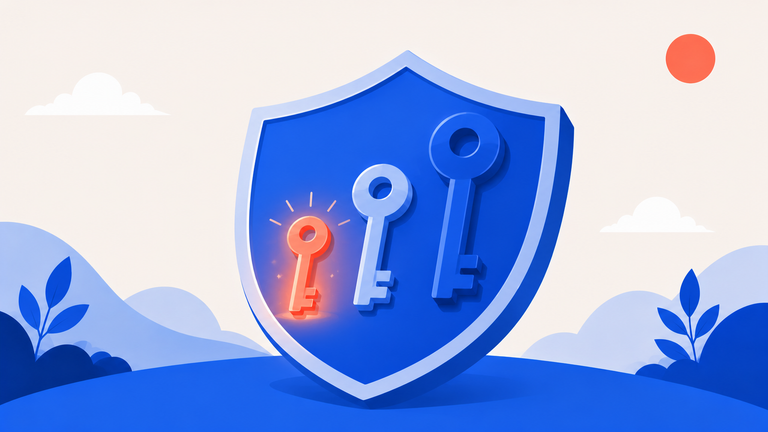
One account, several keys
A Hive account does not have one key, it has a small hierarchy of them and the hierarchy is the security model. Each key unlocks a different level of power, so you can use the weak key daily and keep the strong ones locked away.
The posting key is your everyday key. It signs the social actions: publishing posts, commenting, voting, following. If someone stole it, they could post as you, which is bad, but they could not touch your funds or take over the account. This is the only key that should ever be near your daily routine.
The active key is your money key. It signs transfers, powers Hive up or down and handles market and wallet operations. Treat it like a bank credential: used deliberately, on occasions, never left logged in anywhere you don't trust.
The owner key is the master key. It can change all the other keys, including itself and it is what account recovery ultimately hangs on. You should use it almost never. Its job is to exist, offline, in a safe place, for the rare day you need to rotate keys after a scare.
There is also a memo key, used for encrypting private memos attached to transfers. Lower stakes, but part of the set.
Behind all of these sits the master password you may have received at signup, from which the individual keys are derived. Whoever holds the master password holds everything, so it belongs at the same protection level as the owner key: offline, backed up, nowhere near a browser.
The rule of thumb that summarizes the whole hierarchy: log in with the least powerful key that can do the job. For 95 percent of your life on Hive, that is the posting key.
Signers: how logging in actually works
You rarely paste raw keys into apps and you should not. The ecosystem has dedicated signing tools that hold your keys and sign actions on your behalf, so the app you are using never sees them. Ecency supports the main ones.
Hive Keeper is a browser extension, in the spirit of a password manager for Hive. The site shows a request and you confirm it, so nothing sensitive ever touches the app you are browsing on.
Ecency mobile app, mobile app lets you login into any Hive integrated dapps via internal deep linking or via supported browser extensions like Keeper, Keychain, Vault, so one app to do everything on Hive.
Hive Keychain is a browser extension, in the spirit of a password manager for Hive. Your keys live in the extension, encrypted and when an app wants to do something it asks Keychain, which prompts you to approve.
Hive Signer is a web-based signer. Apps redirect you to it to approve actions, in a flow that will feel familiar if you have ever used "sign in with" buttons, except the authority stays with you.
Hive Auth, authentication system working view websockets, has extension and mobile app supported within some browser extensions as well.
Peak Vault is a browser extension, similar to Keychain and Keeper, handling secure transaction signing.
MetaMask works too: if you already live in the Ethereum world and other chains, a Hive extension for MetaMask lets it manage and sign with your Hive keys alongside everything else it holds.
None of these is the wrong choice. Pick the one that matches how you work and let it keep your keys out of copy-paste circulation. You can also log in on Ecency with your posting key directly, which is exactly what that key is scoped for.
Backup habits that actually hold up
Make more than one copy. Two at minimum, in different places, so no single fire, theft, or coffee spill is fatal.
Keep the strong keys offline. Owner key and master password belong on paper or encrypted offline storage, not in a notes app, not in your email, not in a screenshot in your camera roll. A password manager is a reasonable home for the posting key you use daily.
Check your backups once in a while. A backup you have never verified is a hope, not a backup.
And write down for yourself which key is which. Future you, mildly panicked, should not have to guess.
The classic mistakes
Every one of these has cost someone an account or a wallet, so learn them the cheap way.
Using the owner key or master password to log in to everyday things. Pasting keys into random websites that promise stats, airdrops, or giveaways. Sharing a key with "support staff" in DMs, who are always, without exception, scammers, since no real support needs your keys. Keeping the only copy on one phone that then falls in a lake. Storing everything in a cloud note behind a weak email password.
The pattern behind all of them is the same: a powerful key drifting into a low-security place.
The trade, honestly stated
Passwords with reset buttons feel safer because someone else is responsible. Keys feel heavier because you are. That weight is not a bug. It is what ownership is made of and on Hive it is why your account, your content and your audience cannot be confiscated by anyone.
Set up your keys properly once, build the two or three habits above and the burden effectively disappears. What remains is an account that is genuinely, cryptographically yours.
Your blog, your keys. Literally. ecency.com
Thank you for sharing this important information. Many people aren’t aware of how important it is to safeguard their crypto keys.
After reading this article, I now have a better understanding of the function of each key.
@ecency, interesante lo que compartiste sobre HIVE. Si el soporte de $0.046 se mantiene firme, el piso parece estar formándose. La comunidad sigue construyendo y eso es lo que realmente sostiene el valor a largo plazo. ¿Cómo ves el futuro de HIVE con respecto a otras chains de contenido?
Gracias por compartir esta guía. Muchas veces, cuando comenzamos en Hive, no entendemos la importancia de proteger nuestras claves. Con el tiempo aprendemos que la seguridad también forma parte de la responsabilidad de ser dueños de nuestra cuenta. Es un excelente recordatorio para guardar las claves correctamente y utilizar cada una para el propósito que fue creada. Gracias por educar a la comunidad.
Saludos.Muchas gracias por la información,muy oportuna.Sobre todo para mi que soy nueva en esta comunidad me ha servido de gran ayuda.
I kept coming back to this 'Keys, Not Passwords: A Plain-Language Guide to Hive Account Security', it's the kind of post that makes the feed better.