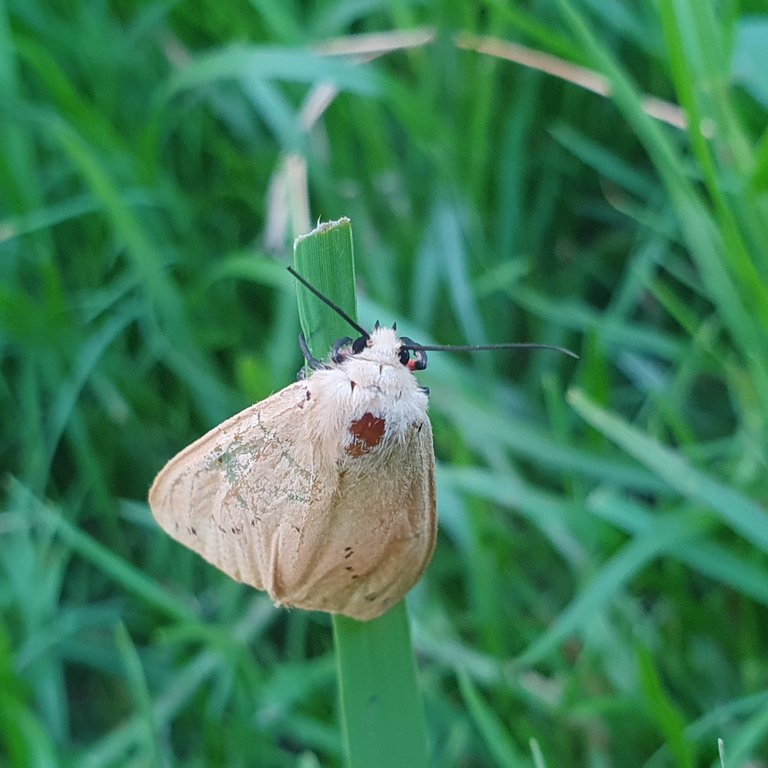
| Latin Name | Observation Date | Location |
|---|---|---|
| Spilarctia bisecta, | Jun 02, 2026 | Purulia, Natore, Bangladesh |
Hello Nature Observer friends. Hope everyone is well and having a great time with nature.
I always love to see small insects and their details in nature through the camera lens. There are many such beauties hidden in the grass or bushes that escape our eyes. Today I am going to share with you the detailed information of a wonderful moth or insect that I captured on my camera.

Common name and scientific name: In common language, it is known as a moth of the Tiger moth species. Its scientific name is Spilarctia bisecta, which was first described by John Henry Leach in 1889.
Family and Genus: The moth belongs to the Erebidae family and is part of the Arctiinae subfamily. Its genus or genus is Spilarctia. However, historically it was classified under the Spilosoma genus.
Native and Habitat: This moth is mainly found in Asia. They are distributed in various regions of China (such as Shanghai, Hong Kong, Sichuan, Jiangxi, Shandong, Jiangsu, Zhejiang, Hubei, Hunan, Fujian, Guangdong, Guangxi, Guizhou, Yunnan, Tibet, etc.).
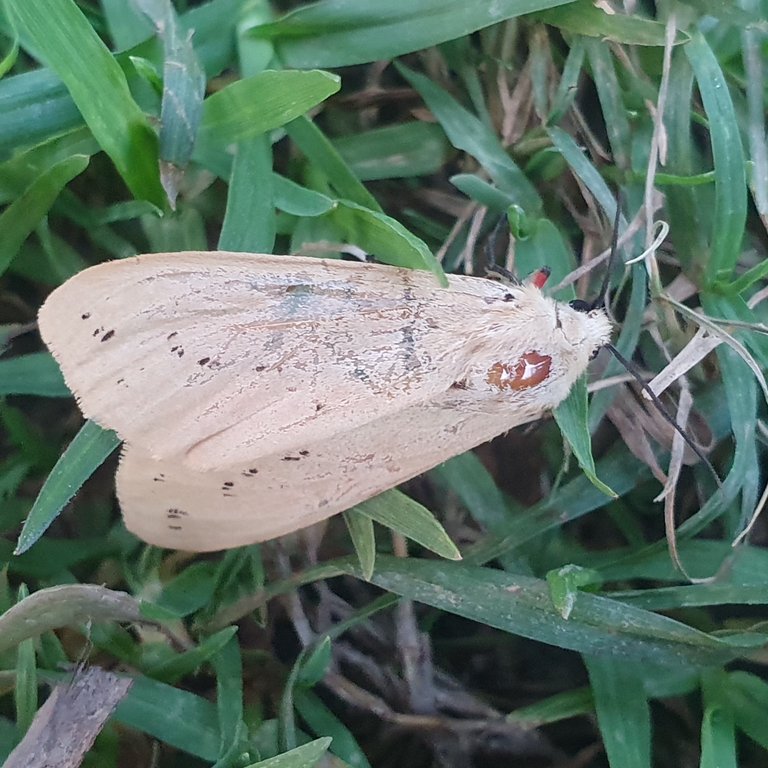
Size and physical characteristics: Their wingspan is approximately 47 millimeters. The front wings are light buff in color, with a distinct and discrete row of black spots from the middle to the tip. Their hind wings are also light buff in color and also have black dots.
Diet and reproduction: Like ordinary tiger moths, their larvae or caterpillars survive by eating the leaves of various plants. However, adult moths mainly drink nectar from flowers. In reproduction, they lay eggs and the eggs hatch into caterpillars. The caterpillars later go into the pupa stage and from there such beautiful full-fledged moths are born.
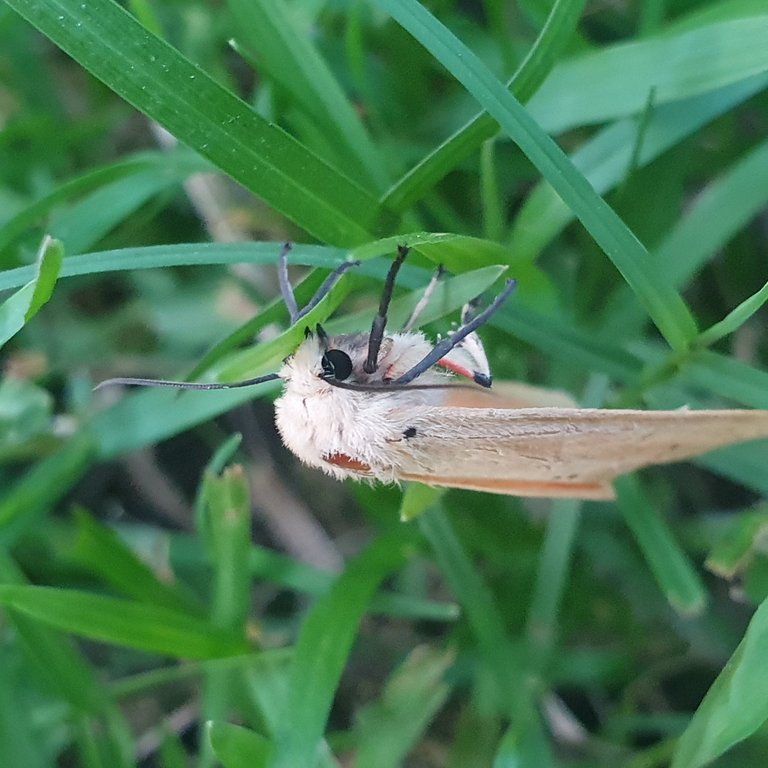
Benefits and disadvantages: They play a great role in maintaining the balance of the environment. At night, they help pollinate various flowers. In addition, they are an important part of the food chain or ecosystem as food for frogs, lizards and various birds. Speaking of disadvantages, full-fledged moths do not directly harm us or nature. However, the caterpillars that hatch from the eggs sometimes eat the leaves of agricultural land or garden plants, which can cause minor damage to the crops in some cases.

There is infinite beauty hidden among these small creatures of nature. I hope you liked the pictures and information I took. Don't forget to share your constructive opinions in the comments.
I learned about them from various sites including iNaturalist, Wikipedia and Google.
(All posts are written in Bengali and translated into English using Google Translate.)
.
.
| Camera Used | Samsung SM-G973F |
|---|---|
| F-Stop | F2.4 |
| ISO speed | ISO |
| Focal length | 26mm |
| Flash | No |
| Editing app | No |
| Photography | (Spilarctia bisecta,) |
| Photographer | @mshbd |
| Location | Purulia, Natore, Bangladesh |
| Link to original community |
|---|
| https://www.inaturalist.org/observations/367813145 |
| Latitude | Longitude | Map Link |
|---|---|---|
| 24.3360 | 89.1123 | https://www.openstreetmap.org/?#map=12/24.3360/89.1123 |
Love these posts with great photos and id info
Hey @fenngen, Thanks a lot for sharing my post and for the kind words. I'm really glad you enjoyed the photos and the ID details. It means a lot to me.
Congratulations @mshbd! You have completed the following achievement on the Hive blockchain And have been rewarded with New badge(s)
Your next target is to reach 100 posts.
You can view your badges on your board and compare yourself to others in the Ranking
If you no longer want to receive notifications, reply to this comment with the word
STOPCheck out our last posts:
Thanks for your contribution to the STEMsocial community. Feel free to join us on discord to get to know the rest of us!
Please consider delegating to the @stemsocial account (85% of the curation rewards are returned).
Consider setting @stemsocial as a beneficiary of this post's rewards if you would like to support the community and contribute to its mission of promoting science and education on Hive.