| Latin Name | Observation Date | Location |
|---|---|---|
| Sphrageidus similis | May 19, 2026 | Purulia, Natore, Bangladesh |

Using i-Naturalist and Google Lens, I can find out that this is a special type of moth. Let's learn more about this beautiful insect today.

Name and Family: After searching for information, I found out that the common English name of this white insect is Yellow-tail moth or Swan moth. In zoology or as a scientific name, it is called Sphrageidus similis (its previous name was Euproctis similis). It is basically a type of Tussock moth belonging to the Erebidae family. Although their entire body is white like a swan, they have a tuft of yellow or golden hairs at the very end of their tail, which is why they have been named like this. In addition, the tufts on their heads look exactly like bird feathers.
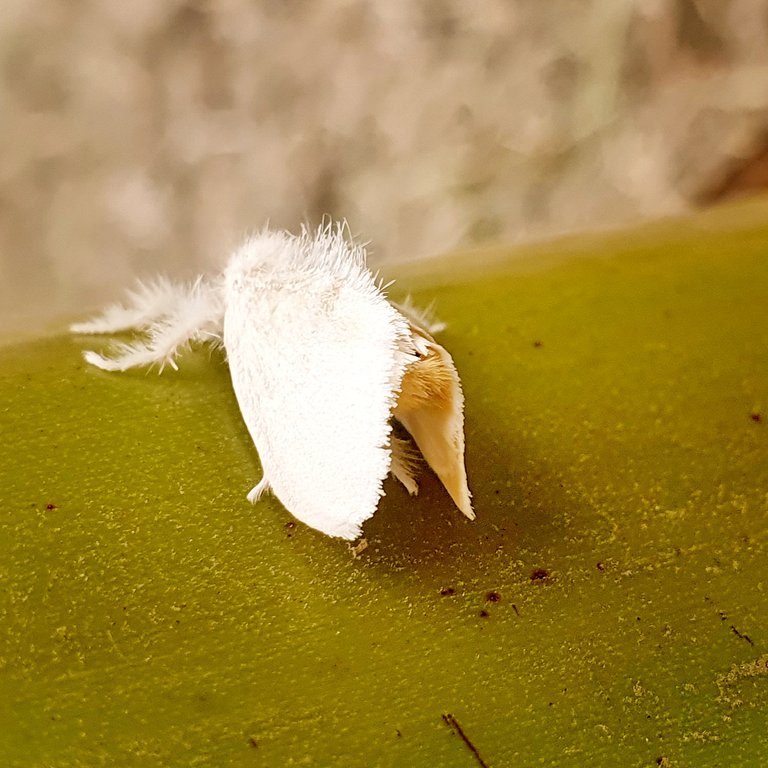
Indigenous and Habitat: These moths are mainly native to various parts of Europe and Asia. They can also be found in the natural environment around us. They usually prefer to live in large-leaved trees, shrubs, forests, and parks or gardens. They are nocturnal animals, so during the day they rest quietly on the leaves of trees or behind branches, and at night they fly around attracted to light.

Food and reproduction: Interestingly, after becoming a full-fledged moth or butterfly, they do not eat much food. They only drink a little nectar from various flowers to survive. However, their larvae or caterpillars are quite gluttonous, they grow up eating the leaves of willow, birch, apple or oak trees. In terms of reproduction, female moths lay eggs on the leaves of trees and protect the eggs with those yellow hairs on their tails to protect them from predators.

Although this beautiful white moth is a natural part of nature, its larvae or caterpillars can be quite harmful to humans and crops.

Benefits: Although they are not directly useful to us, they help maintain the balance of the natural food chain or ecosystem. These moths play a great role as the main food for bats and various nocturnal birds and spiders at night.

Harms: Although the full-grown moths are harmless, their caterpillars or caterpillars have a type of poisonous and irritating hair on their bodies. If these hairs come into contact with human skin, severe itching, allergies or rashes can occur. In addition, they also cause some damage to farmers by eating the leaves of various fruit trees in groups.

I learned about them from various sites including iNaturalist, Wikipedia and Google.
(All posts are written in Bengali and translated into English using Google Translate.)
.
.
.
| Camera Used | Samsung SM-G973F |
|---|---|
| F-Stop | F2.4 |
| ISO speed | ISO |
| Focal length | 26mm |
| Flash | No |
| Editing app | MIX |
| Photography | Swan moth (Sphrageidus similis) |
| Photographer | @mshbd |
| Location | Purulia, Natore, Bangladesh |
| Link to original community |
|---|
| https://www.inaturalist.org/observations/363391540 |
| Latitude | Longitude | Map Link |
|---|---|---|
| 24.3360 | 89.1134 | https://www.openstreetmap.org/?#map=12/24.3360/89.1134 |
Thanks for your contribution to the STEMsocial community. Feel free to join us on discord to get to know the rest of us!
Please consider delegating to the @stemsocial account (85% of the curation rewards are returned).
Consider setting @stemsocial as a beneficiary of this post's rewards if you would like to support the community and contribute to its mission of promoting science and education on Hive.
Congratulations @mshbd! You have completed the following achievement on the Hive blockchain And have been rewarded with New badge(s)
Your next payout target is 1000 HP.
The unit is Hive Power equivalent because post and comment rewards can be split into HP and HBD
You can view your badges on your board and compare yourself to others in the Ranking
If you no longer want to receive notifications, reply to this comment with the word
STOP