This week, Google made one of the most loaded presentations we’ve seen in years.
And to understand how big of a turnaround this is, keep one number in mind. Just 18 months ago, Google looked like the biggest loser in the AI race. It had spent more than a decade preparing, and then OpenAI came in and took the spotlight right out of its hands. Today? The stock is up 130% over the past year. And at this year’s Google I/O event, the company showed exactly why.
THE NEW MODELS
Let’s start with the basics. The models.
Google introduced Gemini 3.5 Flash. A lighter model that, according to CEO Sundar Pichai, delivers top tier capabilities at half, and in some cases one third, of the cost of competitors. And as he said, it is “extremely fast.” In fact, 3.5 Flash is now becoming the default model inside both the Gemini app and the AI Mode in Search worldwide.
“You no longer have to sacrifice quality for speed,” the company wrote. It also said the model has improved safety protections, making it less likely to generate harmful content.
Its heavier sibling, Gemini 3.5 Pro, is already being used internally and will launch more broadly next month.
And this is where things get even more interesting. Because Google also introduced Omni, a “world model.” What exactly is that? In very simple terms, it is a model that simulates the physical world. It predicts what will happen next based on your actions. It will work across the Gemini app, YouTube Shorts, and other products, and users will literally be able to say, “take this video and change what happens.” Add characters, objects, or new actions.
THE ERA OF AGENTS
If there was one theme running through the entire event, it was agents.
This is where Spark comes in. A “24/7 personal assistant” inside Gemini. “How is that different from Gemini itself?” you might ask. The idea is that Spark continuously runs in the background of your life. It connects to all your Google tools, can pull a Google Doc from an email for example, and soon will connect with third party apps like OpenTable, Spotify, and Uber.
In other words? This is the personal AI assistant companies have been promising for years. It organizes your life, highlights important updates, and brings order to your files. It will launch in beta for Ultra subscribers paying $200 per month, but could eventually become available to everyone.
And it does not stop there. Google also wants Gemini to shop on your behalf. Imagine saying “organize a barbecue,” and it builds the menu, opens Instacart, fills the cart with ingredients, and notifies you once everything is ready. That is exactly the kind of scenario company executives described.
“Add that up multiple times a day, and it’s a huge amount of time you get back,” one executive said.
THE NEW SEARCH AND THE GLASSES
Now let’s move to something that affects literally all of us. Search.
Google redesigned the Search box itself. Pichai called it the biggest upgrade to Google Search in 25 years. The box now dynamically expands so you can type longer natural language questions, suggests smarter queries, and lets you ask follow up questions directly on the page. Subscribers will also get “information agents,” a much more advanced way to stay updated on topics they care about.
And as if that wasn’t enough, Google is also entering the smart glasses market. In partnership with Samsung, Warby Parker, and Gentle Monster. The glasses will include Gemini, speakers, microphones, and cameras, and they will work with both iPhone and Android devices. During a live demo, a company executive ordered coffee through DoorDash using a simple voice command, read unread messages, and added an event to the calendar.
And why does this matter? Because this is Google going directly after Meta. Meta’s Ray-Ban smart glasses sold 7 million units in 2025. The difference? Google’s glasses will run on Gemini, which is a significantly more capable assistant.
THE REAL GOLDMINE
And this is where I really want to focus. Because the most important thing may not be the gadgets. It may be what people do not immediately see. The cloud business and the chips.
Google Cloud grew 63% year over year, outperforming both Amazon and Microsoft. Its backlog reached $462 billion.
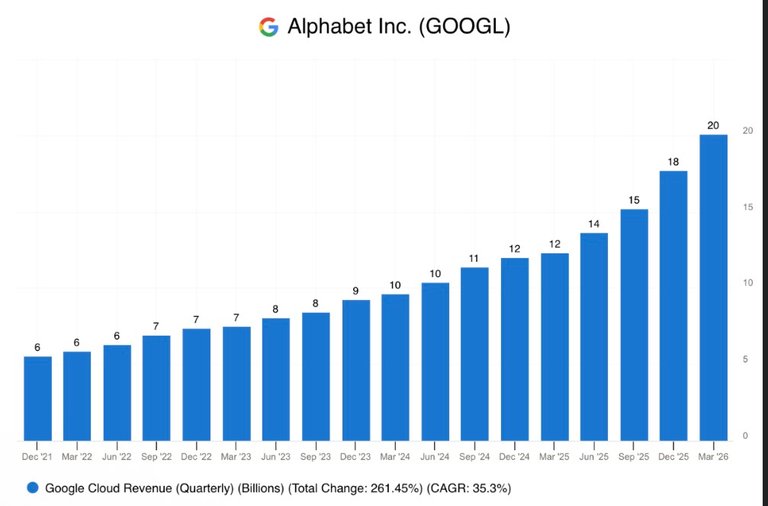
And now to the chips. Google is building its own TPUs, custom AI processors, and starting in the second half of 2026 it will begin selling them to external customers. That creates an entirely new revenue stream.
And pay attention to this. Just this Monday, Blackstone, the world’s largest private owner of data centers, announced a $5 billion investment into a new AI infrastructure company together with Google, powered by TPUs.
There is also the Anthropic angle, where Alphabet owns a significant stake. Reportedly, there is a cloud commitment worth as much as $200 billion and investment exposure reaching up to $40 billion.
In simple terms? Even if businesses choose Claude instead of Gemini, Google still wins. Because all of that AI activity still needs infrastructure to run on. And that infrastructure runs on Google’s TPUs.
