
Exposición "Reencarnación y Descolonización: Un Arte desde el Sur" Nahu Padilla - 12/2/26 -UNEARTE - S3
Esta presentación expone una tesis de especialización titulada Reencarnación y decolonización: Un arte desde el Sur, que propone una metodología artística basada en la excavación de saberes ancestrales y su actualización tecnológica. Organizada en siete "estratos" en lugar de capítulos, la investigación articula el linaje del autor —conectado a figuras como Guaicaipuro y mi bisabuelo el curandero Juan Evangelista Arbeláez— con herramientas contemporáneas como programación en Python y visualización sonora con PhonoPaper. El "pukuinstrumento", una instalación percutiva escultórica, funciona como dispositivo de recolección de datos sensibles y como puente entre el pulso ancestral y el código binario, validando la reencarnación como categoría de análisis académico y la transmaterialidad del espíritu al dato digital.
Mi trabajo se enmarca en una justicia epistémica y simbólica frente al bloqueo y las sanciones que afectan a Venezuela, transformando la carencia de recursos en soberanía tecnológica. Apoyándose en la etnografía sensible de Miguel Martínez Miguélez y la netnografía de Narváez y Carmona, la investigación reivindica el cuerpo, el sonido y el error como rastros humanos válidos frente a la perfección digital hegemónica. El resultado es una praxis decolonial que posiciona al artista-investigador del Sur no como objeto de estudio, sino como sujeto de poder, capaz de codificar su propia memoria colectiva y ofrecer una pedagogía replicable para otras creatividades en resistencia.
Spanish:
Mi trabajo como artista y docente siempre ha sido una búsqueda por entender el arte como un espacio de descubrimiento constante, un vínculo sensible entre lo técnico y lo sagrado. Me veo como un explorador de procesos vivos que nos invitan a repensar nuestro rol en la transformación social, donde el tiempo de la creación no es algo estático, sino una activación crítica que apenas comienza. En esta clase magistral, quise abrirles las puertas de mi laboratorio personal para mostrarles cómo el sonido, la ingeniería y la materia se funden en una sola energía: una que permite pintar lo invisible y redimensionar nuestra realidad a través de la experimentación tecnológica y el gesto manual.
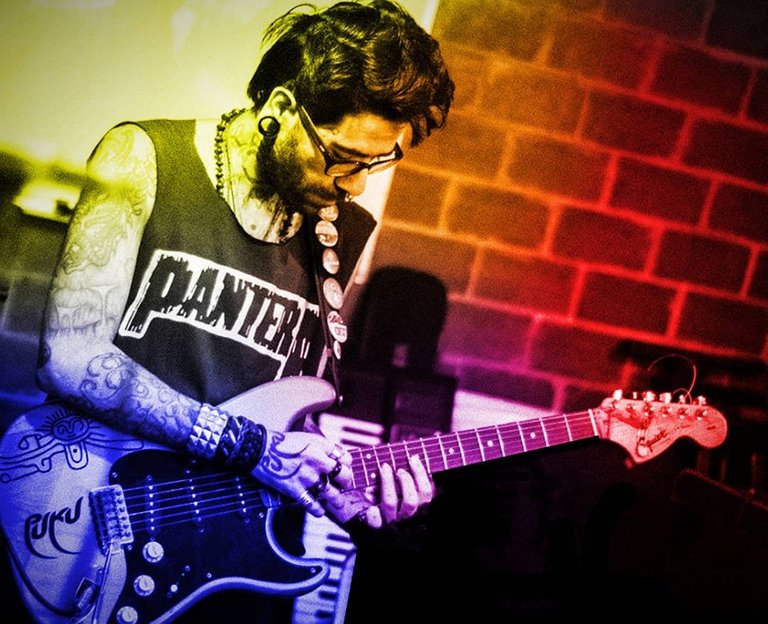
Acá pueden "ver" mi método para "pintar el sonido", una búsqueda que nació de mi necesidad de fusionar la fotografía y la ingeniería informática con el arte plástico. Todo empezó usando apps como PhonoPaper para entender cómo un gráfico puede contener audio, pero mi curiosidad me llevó a programar mi propio software en Python. Con esta herramienta, logré que el micrófono funcione como un pincel: cuando toco mi batería de percusión —una escultura gigante que yo mismo construí—, el sistema traduce cada golpe, ritmo y frecuencia en trazos y texturas únicas en la pantalla. No es algo automático ni predecible; es puro action painting digital donde cada sesión de improvisación genera un lienzo irrepetible.
Sin embargo, para mí la obra no es real hasta que sale de la computadora y se vuelve materia. Por eso, imprimo estos resultados en papel glasse 300 y los intervengo físicamente: uso tijeras, óleo, hilos y hasta materiales de reciclaje para darles volumen. Lo que empezó como una onda sonora termina convertido en una escultura o una instalación de gran formato, como las que he tenido la oportunidad de exponer en la Bienal del Sur, en el Museo de Bellas Artes de Caracas. Me interesa que vean que el lienzo en blanco no tiene por qué ser el punto de partida; mi lienzo es el sonido y mi proceso es una deformación constante de esa energía.
Finalmente, les enfaticé que más allá de la tecnología, lo que importa es el concepto y el discurso que sostiene a la pieza. Mis obras, como la serie de las hachas, no son solo estética; son tótems que recontextualizan lo sagrado y lo indígena desde un lenguaje contemporáneo que incluye hasta la inteligencia artificial como experimento. Al final del día, mi labor como artista es redimensionar los materiales y no ponerme límites: si una foto puede ser audio y un audio puede ser una escultura, entonces las posibilidades de creación son realmente infinitas.
Previous Post:
El borrador:
https://peakd.com/hive-158694/@nahupuku/a6c87935

Clase Magistral: Pintando el Sonido por Nahu Padilla - 6/2/2026
https://peakd.com/hive-158694/@nahupuku/77674215
Unearte Taller de Fotografía
CECA, Armando Reverón
Caracas, Venezuela
Prof. Juan Carlos Lugo
Nota:
A partir del minuto 16:27 en adelante hay imágenes y video, hasta el minuto 39:34
Links:
https://www.warmplace.ru/soft/phonopaper/
https://warmplace.ru/soft/ans/
https://www.secondinversion.org/tag/phonopaper/
https://en.wikipedia.org/wiki/ANS_synthesizer
https://en.wikipedia.org/wiki/Yevgeny_Murzin
PukuDrumz Art Digital - 4 Artworks by @nahupuku - LNC -2024
Pintando el sonido con mi PukuInstrumento - by @nahupuku - LNC - 2025
MAPAS SUBJETIVIDADES SEM III - Nahu Padilla -2/2/2026 - Unearte PNFA Artes y Culturas Pueblos del Sur
Otros Links de Interés:
Bienal del Sur - Obra Hachas de Guaicaipuro - Vídeo 2025 - Nahu Puku
Nahu Padilla VideoArte Bienal del Sur - Venezuela
Obra:
Hachas de Guaicaipuro - Pintando el Sonido - 2025
2do Encuentro Pensamiento Estético en Progreso - El cuerpo reencarnado - Lic.Nahu Padilla @nahupuku
Explicación de la Obra:
Video detrás de cámara de la creacion de la obra:
Nahu Padilla: @nahupuku - Teclados - Bateria
Documental Completo:
Edited in: Caracas, Venezuela.
En la Nevera Creativa PukuEstudio - NNR
Previous Post:
https://peakd.com/hive-158694/@nahupuku/fde4973f
PhonoPaper App por Alexander Zolotov
Inspirado en el Sintetizador Ruso ANS
creado por Evgeny Murzin desde 1938 a 1958
https://www.warmplace.ru/soft/phonopaper/
https://www.warmplace.ru/soft/ans/
My Networks:
https://www.tiktok.com/@nahupuku
https://www.instagram.com/nahupuku/
https://www.instagram.com/nahupukualienart/
https://www.instagram.com/laneveracreativa/
All photographs and videos are my property / Todas las fotografías y videos son de mi propiedad.

PukuEdición by me, 2026 - NNR
PukuNetworks:
Bendiciones y gracias por ver mi post
Blessings and thanks for watching my post
▶️ 3Speak