Succinic acid, or also 1,4-butanedioic acid, is a carboxylic acid of four carbon atoms, which is currently in great demand in the chemical industry, mainly because it is a precursor compound of a great variety of other products necessary for the pharmaceutical, food and food industries, since it can be used as a building block to obtain more complex molecules. But like most organic acids, it is produced by chemical synthesis, generating polluting currents in the process, however, thanks to the evolution of synthesis methods, it can also be obtained from products derived from agro-industrial raw materials, since it is an acid that also occurs in nature, in fact it is present in ripe fruits and is also produced by the fermentation of sugars; therefore, new production methods can be incorporated, generating less pollutant load.
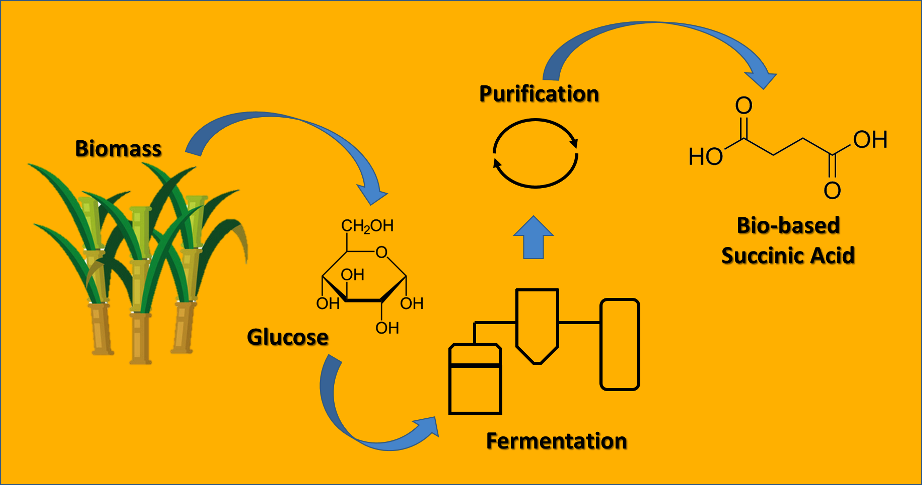
Simple scheme of the succinic acid production process by fermentation. Source: image elaborated in PowerPoint.
Succinic acid is used as a precursor for other molecules of industrial interest because of its potential as a building block for C4 compounds, since its terminal carboxyl groups facilitate the synthesis of other compounds, such as the polymer polybutene succinate, tetrahydrofuran, 1,4-butanediol or 1,3-butadiene and their derivatives, which are important in the petrochemical industry, making it indispensable for the manufacture of resins, polymers, detergents, herbicides and other products.
Most succinic acid is produced petrochemically from n-butane by oxidation to maleic anhydride and catalytic hydrogenation in the final product.

Schematic diagram of the petrochemical production of succinic acid. Source: @emiliomoron, structures of maleic anhydride and succinic acid are in the public domain.
But it is also produced naturally as an intermediate in the tricarboxylic acid (TAS) cycle, or as a product of the anaerobic fermentation of some microorganisms. For example, there are microorganisms that possess a highly efficient reductive pathway for succinic acid synthesis, such as the anaerobic bacteria Anaerobiospirillum succiniciproducens, Actinobacillus succinogenes, Mannheimia succiniciproducens and Basfia succiniciproducens.

Diagram of the citric acid cycle or tricarboxylic acid cycle. Source: Wikimedia.org.
That is why in the last decade many companies have industrial processes in demonstration stages for the production of succinic acid by fermentation, increasing the production of this acid by more sustainable means, for example using the fermentation of renewable substrates, since succinic acid can also be obtained by aerobic fermentation of starches and sugars from C5 to C6. And while petrochemical production of one ton of succinic acid generates approximately 7 tons of greenhouse gases, the fermentation route has zero emissions and consumes 60% less energy.

Schematic of biological production of succinic acid. Source: @emiliomoron, images of biomass, glucose, sucrose and succinic acid are in the public domain.
The fermentation production pathway has been well studied, and many contributions have been made to improve the process, selecting and studying several microorganisms that can produce succinic acid, such as fungi, yeasts and Gram-positive bacteria.
It has been reported that A. succinogenes is capable of using a great variety of sugars as carbon source, such as fructose, galactose, glucose, matosa, among others; being able to degrade complex substrates such as sugar cane, corn stover or glycerol. It is also well documented that the metabolic route for the biosynthesis of succinic acid produces two four-carbon acids for each molecule of glucose used by the carboxylation reaction of phosphoenolpyruvate carboxylase.
However, these anaerobic methods have their limitations for industrial scale application, mainly due to their high oxygen sensitivity and relatively slow growth rates.
But bio-based succinic acid production has significant advantages over the petrochemical route, especially with regard to material sustainability and energy savings, so further implementation of this large-scale procurement method can be driven by optimization of the fermentative process.
Well friends, let's hope that research on the use of microorganisms and sustainable feedstock sources to obtain chemical compounds of great value to the industry and reduce the carbon footprint in the manufacture of many chemical products will continue to advance. See you next time!
References
Eduardo Hernández Correa (2018). Production of succinic acid by Actinobacillus succinogenes from hydrolysate of the organic fraction of municipal solid waste by microbial electrosynthesis. online thesis.
M. Papagianni, Organic Acid. In Comprehensive Biotechnology (Second Edition), 2011, Pages 109-120.
José M.Pinazo (2015). Sustainability metrics for succinic acid production: A comparison between biomass-based and petrochemical routes. Catalysis Today, Volume 239, Pages 17-24.