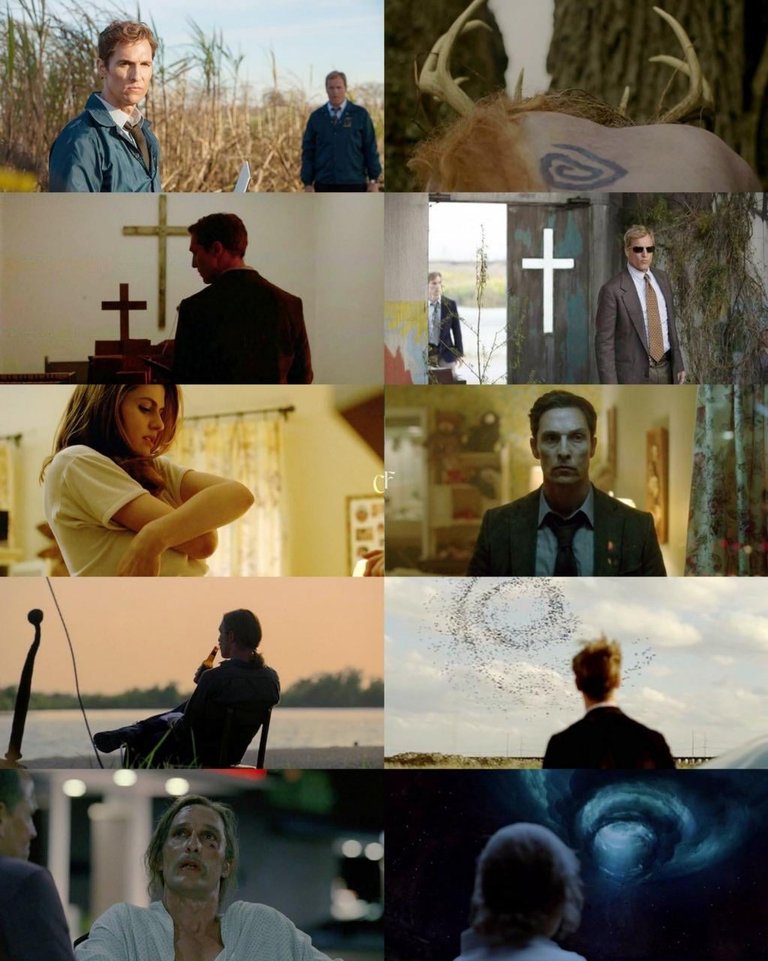
Every time I revisit the first season of True Detective I feel that tug inside me that tells me I am no longer watching television but trespassing into a realm where the skin of the world is too thin to protect anything. The story pretends to follow a linear investigation, yet it spirals into something closer to a slow fever. It drags me into questions I would rather outrun, questions about how easily a person can fracture when confronted with something that does not care about explanation or meaning. I remember the Louisiana landscapes as if they were carved into my own memory, those quiet stretches of land that seem harmless until the air shifts and you sense a presence that does not announce itself. The series never asks me to be entertained. It asks me to stay awake, even when everything in me wants to turn away.
Rarely do characters feel as dangerously familiar as the two detectives leading this descent. I never sympathize with their flaws, yet I understand the echo of their thoughts, the push and pull between believing the world has a structure and suspecting the structure is a lie. There is something unsettling about the way the investigation becomes a mirror they cannot smash. Watching them debate morality feels less like a performance and more like eavesdropping on the private argument each of us has with ourselves when the lights are off. What impresses me is not their brilliance but their vulnerability, that thin line between being a thinker and being consumed by one idea too many. The show captures that territory with uncomfortable precision, where intelligence becomes both weapon and curse.
There is a kind of evil presented here that refuses to be shrunk into a category. Nothing about it is glamorous or stylized. It leaks into the ordinary, into the small routines, into the way a place feels when the sun drops. True Detective understands that real terror is not loud. It is patient. It waits in the corners of institutions that swear they protect us, in the silences that people agree never to break. It is the type of evil that thrives when no one believes in it anymore. The season does not treat darkness as an aesthetic. It treats it as an inheritance, the kind that passes unnoticed until one day it is standing in front of you, familiar and nameless at the same time.
Memories are what the show uses to corner its characters, and maybe that is why it lingers long after the final scene. The storytelling shifts across time not to confuse but to expose the erosion that life inflicts on conviction. When I watch the older versions of the detectives recounting the investigation, there is an ache in their voices that feels more devastating than any revelation in the case. The show suggests that survival is not proof of strength but simply proof that something chose not to take you yet. That idea follows me beyond the episode. It forces me to confront how people adapt to the unspeakable, how some of us build theories to keep the void at a distance while others surrender to whatever the void whispers. The brilliance of the season is that it never reduces these choices to morality. It treats them as human inevitabilities.
Sometimes I think what unsettles me most is not the violence or the mystery but the way the season portrays truth as a moving creature, something you chase knowing it may ruin you. True Detective never promises clarity. Instead it leaves me in a place where answers feel temporary and understanding feels fragile. Yet there is a strange honesty in that uncertainty, an acceptance that the world carries more shadows than we are prepared to acknowledge. I finish the season feeling both emptied and strangely grounded, as if someone forced me to look at a landscape I already knew but never had the courage to truly examine. There is no message of hope wrapped at the end, only the reminder that evil continues whether or not we give it our attention. And still, despite everything, I find myself returning to it, drawn to that rare space where storytelling has the courage to face what most of us spend our lives avoiding.