There is an inescapable fact that we cannot avoid: When it comes to interest rate hikes, there is a lag.
In other words, whatever happens with interest rates, it take a good 9-12 months to filter through the economy. This is something that people often forget. Nothing a central bank does, including the Fed, is immediate. They have their meetings and whatever decisions are made, it is looking out at least 12 months.
The economy is like turning an oil tanker, now a canoe.
Macroeconomic analysis requires looking at things in their proper time frame. Here is where we could be in for a heap of trouble.
We are now seeing data that is backing up what many of us were saying all along: the price increases were not inflation and hence were going to be transitory.
Inflation
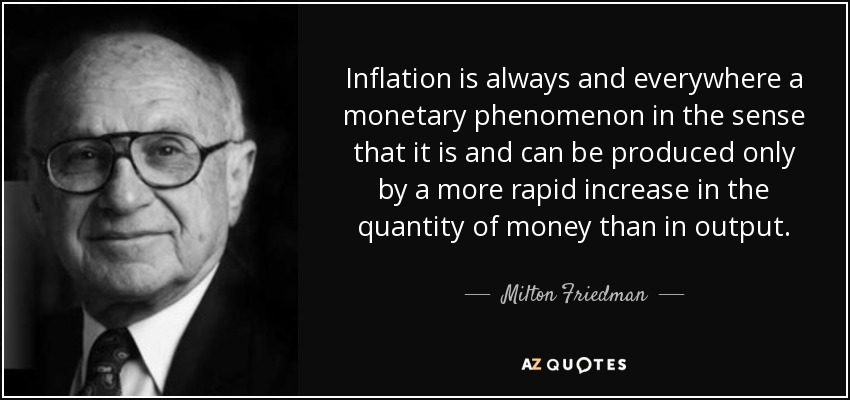
We need to understand inflation. As Milton Friedman said, it is a monetary phenomenon. This means an expansion of the money supply.
Unfortuately, contrary to what the Twitter economists proclaim, there was very little expansion in the USD. In fact, since Q3 2008, the money supply expanded at 1.03% annually. This is derived from going through the Z1.
What took place in 2020 was a massive supply shock. Have you hear CEOs talking about supply chain disruption. This is what took place. There was too much demand for products as production slowed down (due to closing the global economy). Services dropped off a cliff and are still below 2019 levels.
Hence we have the Fed fighting something they didn't create. The simply fact is the Fed has one option: crush demand which also means crash the economy. As Powell stated, raising interest rates does not get any more oil out of the ground.
Since we aren't dealing with inflation, there isn't enough money to sustain higher prices. This is another rather simple concept.
As they say in the commodity world, the solution to higher prices is higher prices.
Eventually people start to shift demand.
This is what happened as we see demand across the board waning. Yet the Fed is still on course to keep raising. In its world of sunshine and flying elephants, the data says all is well.
The Data Is Screaming How Bad Things Are
We started banging this drum even before the first interest rate hike. Inventories in Q4 2021 saw record jumps. This was the first sign things were bad.
Next we had the LIBOR yield curve invert. That was warning sign two.
After that, the Treasury yield curve inverted. By the way, both have gotten sicker throughout 2022.
Housing prices peaked in June 2021 and showed a classic topping pattern throughout the last 18 months. New home construction was showing signs of trouble as builders were having to discount houses as soon as they hit the market.
The automobile sector, globally, is still nothing but carnage. While 2021 did see some improvement, this is an overall 5 year drop.
Commercial banks started to tighten by cutting credit card limits, cancelling HELOCs, and reigning in credit lines.
Suddenly, we start hearing how cars cannot be given away at the auctions. Many dealerships are starting to lay off people. The tech sector is getting hammered, with many companies including Meta and Twitter laying off large portions of their workforce. Even Goldman Sachs is unloading 8% of its employees.
PPI in Germany is dropping. The pricing indexes in China look like a trainwreck. EU growth is likely just about gone. China is likely flat although they will present figures that make it look good.
Yet Powell and his merry band of misfits keep chugging along.
Deflation Tends To Be A Spiral
As stated on numerous occasions, many feel that inflation is bad so deflation is good. After all, it is great when the price of stuff gets less expensive.
The problem with that is we tend to look at things as consumers. This is where most are led astray. We need to understand what the money players and businesses are doing. That is where the impact comes from.
Deflationary spirals are never good. To start, asset prices collapse. Sends defaults skyrocketing. Of course, this is countered by even further tightening of credit, meaning expansion cannot take place.
Companies find themselves with declining sales. Their response is to cut expenses which always means reducing headcounts. As household incomes start to get hit, spending declines.
CFOs are also onboard with this mindset. They start rejecting the funding of projects as companies try to weather the rough patch. Again, this starts to filter throughout the economy as money is pulled.
Sadly, the flip from higher prices to deflationary pressures can be swift.
Even looking at commodities, which have every reason to be elevated, we see some present weakness.
In short, demand is taking over.
When there is a lot of talk about recession, it becomes a self-fulfilling prophecy as people start to prepare like one is coming. The cutback in spending equates to recession forces growing.
People want to look at things on a short-term basis. In macroeconomics, two years is short term. This was always a temporary situation, one that was going to reverse and hard.
It is a safe bet that 2023 will not have inflation as the major economic topic of conversation.
If you found this article informative, please give an upvote and rehive.

gif by @doze
logo by @st8z
Posted Using LeoFinance Beta
Yet another excellent explanation of a very complex topic. Thank you! 😊
that's why looking at long term is better choice
Having to talk about something else in the economy for once will definitely be a relief. In Nigeria, over the 8 years, our current president has been on seat petrol prices have moved from N83 to N250 we saw this on a campaign picture billboard that was next to a petrol station.
There are rumours that Joe Clueless Biden wants to trade commodities with African countries as Trade with Russia has been out of the way for some time, I hope he knows that the weather over there in Russia is very different from what we have in Africa.
While deflation will happen due to the money supply not increasing, I don't really think the stores are going to decrease prices. Wages have also slightly increased and it's not like employers can decrease as they want. The economy is sick but I just don't know where things will go in the future because I think some people won't want to change things back to what they were before.
Posted Using LeoFinance Beta
If stores have inventory that they cannot sell, then eventually they will start discounting.
Companies will indeed not reduce wages, but they will not take new hires and many will start restructuring their business.
That's right. Grocery stores, in particular, have perishable items that need to be sold before they become worthless.
In other retail settings, non-perishable goods are still subject to fashion, seasons, and market trends.
You wouldn't for example, sit on old Sony Playstations if new ones are coming out soon. Other durable goods also have entered the product cycle in which new models are constantly introduced. Devaluation is built-in to the manufacturing. Prices will have to drop.
As for people not wanting to change, they don't get much choice.
Posted Using LeoFinance Beta
Exactly!
Employers adjust when revenues drop by cutting employees. Layoffs always go up as the economy gets sick. This flows through the entire economy.
Posted Using LeoFinance Beta
Are you now trying to say we should embrace inflation and find a way to live with it because deflation is not always good ?
Posted Using LeoFinance Beta
It takes understanding the holistic nature of the economy, including inflation. More money is needed if you want economic growth, which most people think is a good thing. However, it doesnt operate in a vacuum.
People think that inflation is bad because they equate it to price increases which is incorrect. Increasing the money supply can lead to a decrease in prices since technological development expands, which is deflationary. Look at all the money that went into fracting that pushed oil prices down for almost a decade.
Posted Using LeoFinance Beta
This mindset drives me nuts. How great is it when the value of your house is half of what you owe? Or your vehicle's value is half the value of the loan?
Now extend that to the business owner who has packing lines, robots, construction equipment, cranes, bulldozers, tractor trailers, etc. etc. etc. The list goes on and on.
Deflation is the absolute worst unless you are stacked with cash!
Posted Using LeoFinance Beta
How good is it when companies lay people off? Do they think that when revenues decline that companies will sit back and simply keep things as is.
Posted Using LeoFinance Beta
As a small business owner (19 employees) I can tell you layoff are the worst. Not only is there the financial impact of loosing a trained mechanic but there is an emotional impact that can't be quantified. These are people I see and interact with on a daily basis and consider to be "friends".
It is quite infuriating to see people in positions of power act like complete buffoons!
You have explained a very complex topic in simple words.
This caught my attention:
This is a very interesting submission that people fails to understand. My country's (Ghana) economy obviously is currently in some kind of a mess, but the sudden rise on the value of GHC/USDT within these few days made many people think the economy is recovering. Meanwhile we still have a long way to go
You have explained a very complex topic in simple words.
This caught my attention
This is a very intense submission that people fails to understand. My country's (Ghana) economy obviously is currently in some kind of a mess, but the sudden rise on the value of GHC/USD within these few days made many people think the economy is recovering. Meanwhile we still have a long way to go