
Greetings friends of the hive community, especially lovers of Stem content.
On this occasion I want to give a complete description of the mud logging activity and the importance it has in the drilling of oil wells.
While drilling an oil well, the geological formations that are crossed while drilling must be corroborated. This information that is collected from the subsoil can only be done by evaluating the formation cuttings that the formation fluid brings from the subsoil when it completes the circulation cycle.
There are other important activities within the mud logging that are also important in the drilling and construction of an oil well and will be described in this article within a net descriptive framework of petroleum engineering.
Introduction
Mud logging is more than an activity; it is a service that certain companies can provide to the company that is drilling the well. In my experience as a drilling operations engineer I can tell you that this service was provided by multiple companies among which it varies: Data log C.A, Bohai, Sclumberger, Halliburton, among others.
Although this activity is called mud logging, it can be said that mud logging contemplates a detailed record of multiple variables that are analyzed using as a primary source of study the rock cuts that are transported along with the drilling fluid from the subsoil to the surface.
The mud logging activity allows outsourced companies to provide the companies that own the fields to be exploited with the drilling of wells with information about the lithology and content that the drilling fluid may contain with all the clipping material of the formations being traversed during the drilling.
In the early days of well drilling, the log used was the mud logging, and this type of log is still used today, so it can be deduced that it is the oldest known well log.
It is very important in well drilling that the mud logging is done using a water based fluid plus some type of clay like bentonite as the drilling fluid, since for example in well drilling there are gas detectors on the surface that record the level of natural gas that accumulates in the mud (drilling fluid).
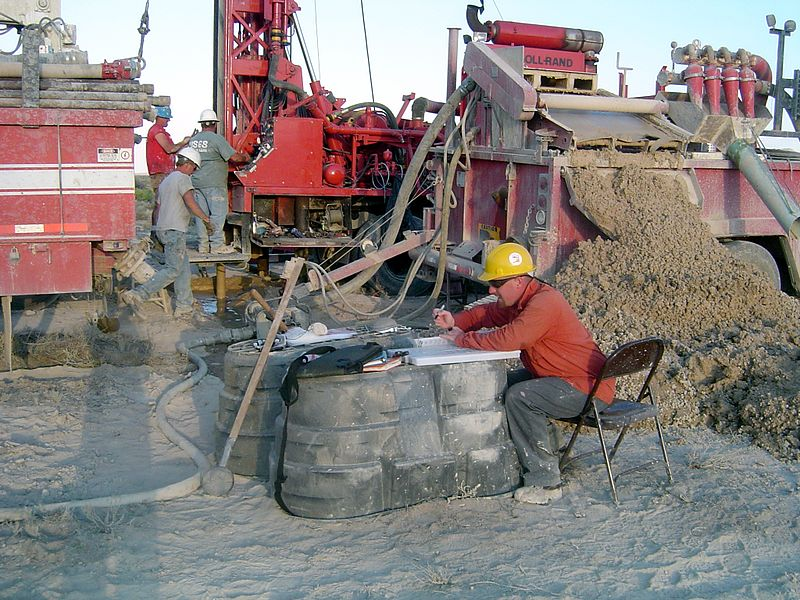
To perform the analysis to the mud samples the service companies that perform the mud logging activity employ a mobile laboratory that must be located very close to the oil platform that performs the drilling, inside this cabin we can see the sample catchers working on the analysis of the samples as shown below:

What service can companies provide regarding moving logging?
One of the main objectives within the operational activities of well drilling is that the mud logging service company can determine the exact depth at which the hydrocarbons are found in the subsoil, for this it is necessary that they analyze the lithologic cut samples present in the drilling mud and in this way be able to identify the type of lithology present at the bottom, another important activity is that they are able to detect the amount of natural gas that can enter from the formation to the well, since if the drilling mud is cut by gas it can lower the density of the drilling fluid.
The mud catcher from the mud logging company must take mud samples that are taken from the solids control equipment and analyze the samples for later discussion of the results obtained from the rock cuttings circulating to the surface in the drilling mud.
The results are recorded in a log called master logg, in which basically for each certain interval of the depth of the well drilled the type of lithography is drawn, for example suppose that 5500 feet to 6800 feet is an interval of sandstone, and then there is an interval of 500 feet of shale, and so on all this information is collected and drawn in the log called master logg.
What is the scope of mud logging?
Once the mud cuttings samples are obtained, their study and evaluation can be extended to the microscopic observation and analysis of such drilling cuttings, not only the analysis is of the formation cuttings, but also extends to the evaluation of gaseous hydrocarbons, even the mud logging is extended to evaluate some chemical and mechanical parameters that are basic for the functions that the drilling fluid must fulfill in the well drilling.
One of the misconceptions of many in well drilling is to believe that the scope of mud logging companies extends only to the analysis of mud logging samples, since even companies have a scope in the study and monitoring of some drilling parameters that are very important to carry out for the good performance in well drilling.
Among the parameters monitored in well drilling by mud logging companies are real time measurements, among which are
Penetration rate (ROP): is the speed with which the drill bit cuts the rock and moves forward in the drilling.
Pumping rate (amount of fluid pumped): is the flow rate (volume/time) that is pumped out of the drilling fluid.
Pump pressure: is the operating pressure of the mud pump.
Weight of the drill bit: this is a very important measurement, since the weight on the bit gives us an indication of many events that have occurred in the well, for example when the weight on the bit is lost it is because a break in the drill pipe has most likely occurred.
Drill String Weight - This measurement is about the entire weight of the drill string measured in Lbs.
Rotation Speed: for drilling to occur efficiently the drill string has to rotate, this rotation is provided by the top drive and is measured in RPM (revolutions per minute).
Mud volumes SPM (strokes per minute): the measurement of the strokes per minute gives us an idea of how fast the pump pistons are working, the flow rate that can be moved and the operating pressure.
Mud weight and mud viscosity: this information is usually obtained by connecting monitoring devices to the rig equipment, with some exceptions, such as mud weight and mud viscosity, which are measured by the rig operator or mud engineer.
From experience I can tell you that the mud logging service companies that were in the drilling of the wells that I supervised did not perform the measurement of these properties (mud weight and viscosity), since the drilling fluid companies were there to supervise these two properties.

In the previous image we can detail some important aspects of what is a mud register, for this we can describe the following:
The blue curve is a record of rock porosity, while the black curve is the record of penetration rate (ROP). There is also a lithological record where the gray color is the description of a lithological formation whose rock is slate, and the yellow color is a formation whose lithological description is a sand type rock.
The green curves are the description of the gaseous hydrocarbons, while the last purple curve is the description of the corrected exponent d.
Detailed analysis of the mud logging
Among the details of the mud registry, there is a very important detail that I want to describe, it is the detail of the lithological description, even though this is a very complex part and it is well mastered by geologists, I as a petroleum engineer must recognize that it is also a competent part of my profession, and that apart from this in the activities that are carried out in the field it is important that the engineer who supervises the activities knows about geology and lithology so that he can make his contributions along with the mud logging company that provides this service.
I would like to explain an example with the following image and the way in which a detailed lithological description can be made:
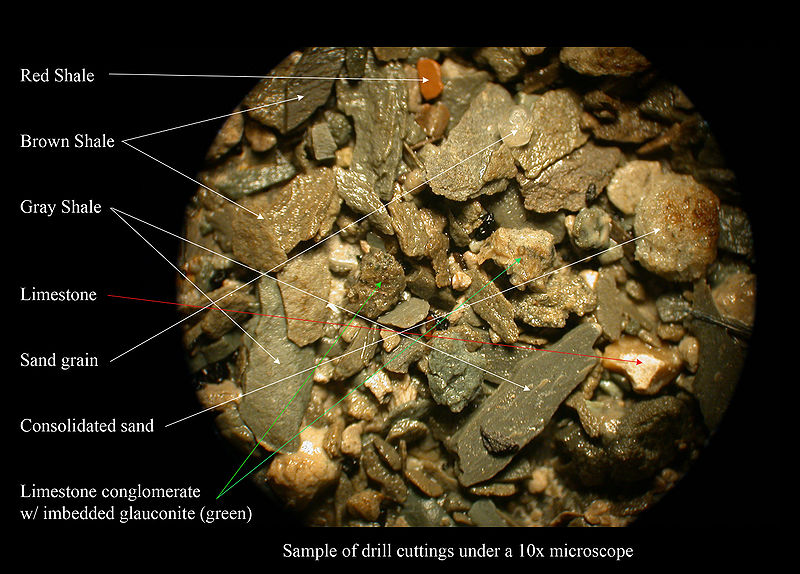
First of all it is important to highlight that you can see in the previous image that it represents a sample of rock cuttings that were taken from a mud sample.
In that sample basically it is possible to arrive at the conclusion in spite of the expressed lithological diversity that it is a set of drilling cuttings composed basically by small cuts of sand and slate.
However, since it is a wet sample and the mud was subsequently washed and subjected to microscopic viewing, a more complete description can be made, in which we can observe small traces of: red shale, brown slate, gray slate, limestone, sandstone, consolidated slate, limestone conglomerate.
Although a lithological diversity is seen in the description of the sample, due to the experience of the geologist who performs the analysis through the microscope, it can be deduced that the most predominant percentage of all that is observed throws a sample of small cuts of sand and slate.
Conclusion and contributions
Mud logging is a service provided by outsourced companies that help keep track of the drilling and construction of the oil well, especially in the phases of the well where it is most needed, such as the intermediate phase, where a lithological study can bring us closer to a study and analysis of how close we are to the producing field.
The other really important thing is that the lithological records that are drawn and represented in the master logg can serve as a guide for when more neighboring wells are drilled in the same oil field.
Through this article with unedited and engineering characteristics, anyone interested in petroleum engineering and the oil industry in general, can refresh their knowledge and corroborate many aspects that give a relevant importance to the mud logging service in the activities of drilling and construction of an oil well and that directly influences the future production of the producing field and all the wells that are drilled to exploit such field.
Finally, it is important to break with the paradigm of thinking that the mud logging service only covers sample analysis, since service companies also extend their services to the control and monitoring of certain drilling parameters such as penetration rate (ROP), revolutions per minute (RPM), pumping rate, pump pressure, strokes per minute. Finally, the supervision of the drilling parameters, which despite the fact that the driller must have control of these parameters is also important to be reinforced by the supervision of the service provided by the mud logging service companies.
Reference consulted and recommended
Observations
- The cover image was edited using Microsoft Power Point 2010 design tools and using the following Image from wikimedia commons
Your post has been voted as a part of Encouragement program. Keep up the good work!
Try https://ecency.com and Earn Points in every action (being online, posting, commenting, reblog, vote and more).
Boost your earnings, double reward, double fun! 😉
Support Ecency, in our mission:
Ecency: https://ecency.com/proposals/141
Hivesigner: Vote for Proposal
Thanks for your contribution to the STEMsocial community. Feel free to join us on discord to get to know the rest of us!
Please consider supporting our funding proposal, approving our witness (@stem.witness) or delegating to the @stemsocial account (for some ROI).
Please consider using the STEMsocial app app and including @stemsocial as a beneficiary to get a stronger support.