Greetings to all and sundry,
It is a good day today, the start of a brand new week or should i say the start of Valentine's week, i know many people have been looking forward to this week, lovers planning special events for their partners, families looking forward to surprising their loved ones. I wish all of us a Happy Valentine's celebration in advance, let's play it safe.

Today i want to talk about the brain and its relation to vision. I decided to talk the route of the brain because lots of time when we are talking about the eyes or vision or sight people just look at the organ within the socket as it is and thinks that that is all that has to do with vision but the truth is, vision is actually done by the brain, that's where the real deal and the complex transactions go on and so let's learn something small about this amazing organ called the brain and its relation with the eye as an organ.
Introduction
Vision starts from light impulses within the environment, before one can see there need to be light because the light impulses are what's going to reflect of the object you are seeing for the cascade of reactions involved in vision to even happen. And so in the evening you wouldn't see as well as during the day and depending on the amount of illumination available you may not see at all.
During the ancient times some war lords used this as a means of punishing their victims, where members were kept in extreme darkness such that they could not even see each other if there were standing next to each other. Some also used to expose their victims to extreme light till all their cells died off and they became blind, yes it is very cruel and i am glad that these atrocities are no longer going on in our contemporary society.
So back to our discussion, when light bounces of the object it travels into the eye with aid of the cornea which refracts or deviates the light towards the retina cells. Also aiding the refraction of light is the lens, the pupils which react accordingly according to the illumination levels, the vitreous and the aqueous humor which also add some amount of refraction based on their refractive indices.
Once these light stimuli gets to the retina and phototransduction process begins thus when we now talk about vision in itself about happening. I am saying this because technically the optic nerve which stems from the ganglion cells of the retina coming together to form it, forms part of the brain and its considered the second cranial nerve. Now when the impulses move from the point of the eye into the optic nerve and into the cranial area we are looking at higher functions, vision and visual stimuli interpretation.
The Brain and Sight
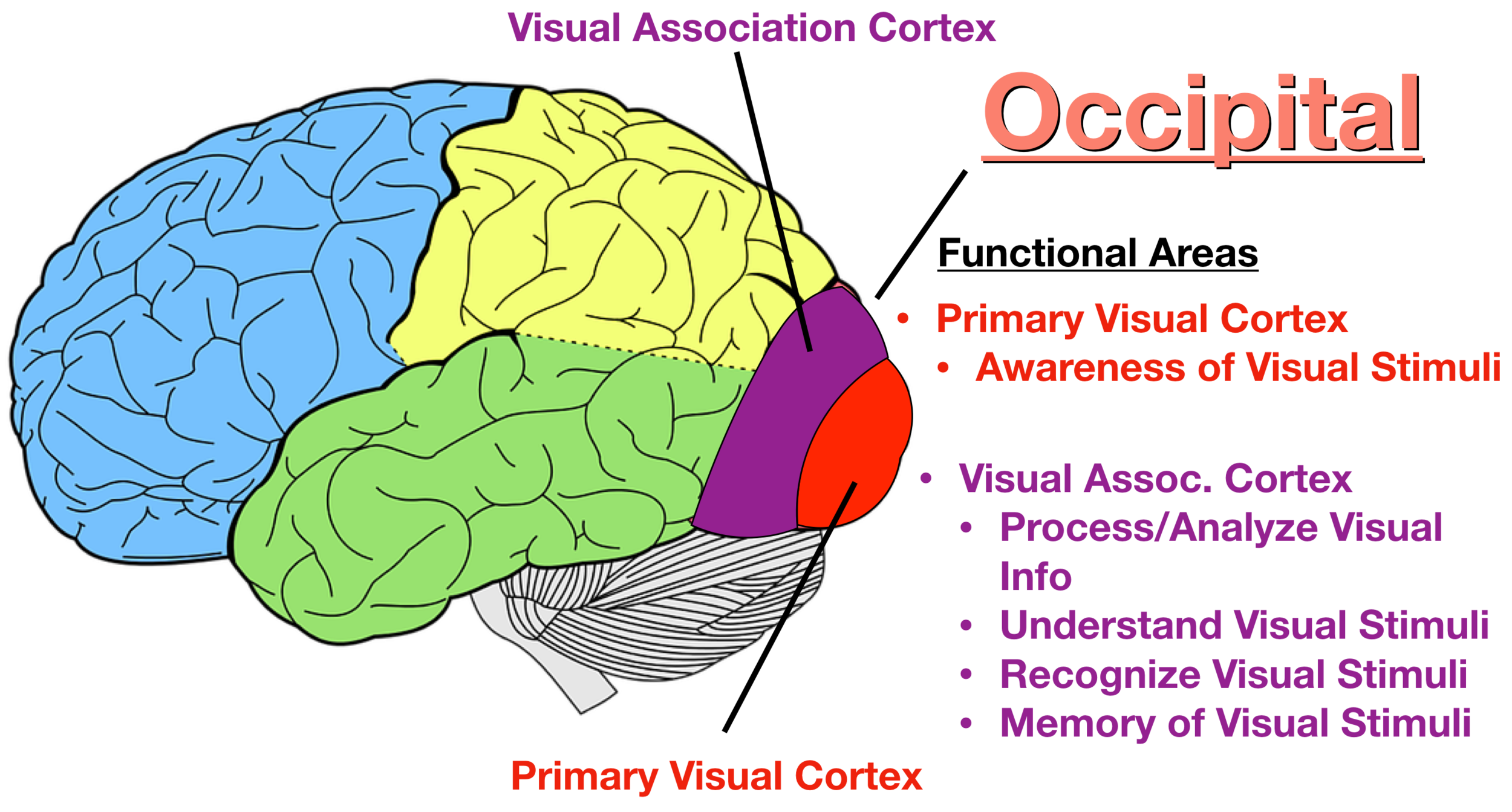
The first set of areas i am going to look at are broadmann areas 17, 18 and 19. These are known as the primary visual cortex, secondary visual cortex and tertiary visual cortex accordingly. Once rays passes the mid-brain the majority of them head first to the primary visual cortex where visual stimuli interpretation begins. Over here we start to appreciate objects as they are, where they are big, small etc.
The primary visual cortex then arrange the information accordingly for it to be sent to the higher cortical areas for more work to be done on it. As it moves up to the secondary and tertiary we are able to appreciate the object based on our knowledge or memories. We are able to tell that this is a tv, this is my girl friend, this is my mum, this is a female or a male and that this is a blue or black color.
Then some of these impulses would also go to broadmann area 8 which can be found at the frontal lobe. Now the frontal lobe has to do mostly with motor actions, voluntary actions or activities as well as higher functions. And so this area basically tells the eye to consciously move in one direction or the other. This area is in play when we direction our attention within our visual space. It is known to work hand in hand with broadmann area on executing these functions.
There are also the amygdala and the superior temporal sulcus which comes to play when we talk about identifying faces. It is with the help of these that a child is able to identify a particular face as being friendly or belonging to the mum or dad or sister etc. The amygdala has other functions that comes to play especially with emotional memories formation. When something goes wrong with any of these one may develop a condition known as prosopagnosia where one is unable to recognize faces they see irrespective of who they may be.
These individuals may be taught to identify faces with the aid of sounds from people as well as studying facial features and other bodily expressions, taking particular care of how specific individuals dress, their routines, the cars they drive etc to be able to predict who a particular individual may be. It is quite an interesting condition, well most conditions that has to do with the brain is quite interesting.
There is also the superior colliculus and the suprachiasmatic nucleus which receives impulses to tell the pupils to constrict or relax based on the amount of light in the atmosphere as well as help control our internal clock, otherwise known as the circadian rhythm. They are the reasons why it may be difficult to sleep during the day or when there is light in the atmosphere. They can be blamed for why some people cannot sleep unless the lights are turned off.
Conclusion
So the brain in itself is a beautiful structure of an organ which is so intricate and well defined so much so that scientist have yet to completely map the brain areas and the functions it play in our daily lives with regards to emotions, our thoughts, attitudes etc. You should try to do more read if you more curious about the brain the way i am but for today this is what i would be serving you. Hopefully we get to learn more intricate stuff in the very near future.

And so even as i wrap up i would like to remind us all to celebrate moderately, let's be safe, let's also be particular about our sight and health, let's do well to avoid over the counter medication and whenever we are in doubt, we should make the effort to speak to a professional lest we find ourselves wanting. It was a pleasure serving you once again today and i wish you the very best. Thanks for reading.
Further Reading
Glickstein M. (2000). How are visual areas of the brain connected to motor areas for the sensory guidance of movement?. Trends in neurosciences, 23(12), 613–617. https://doi.org/10.1016/s0166-2236(00)01681-7.
Barton, J. J. S., Davies-Thompson, J., & Corrow, S. L. (2021). Prosopagnosia and disorders of face processing. Handbook of clinical neurology, 178, 175–193. https://doi.org/10.1016/B978-0-12-821377-3.00006-4
Ganis, G., Thompson, W. L., & Kosslyn, S. M. (2004). Brain areas underlying visual mental imagery and visual perception: an fMRI study. Brain research. Cognitive brain research, 20(2), 226–241. https://doi.org/10.1016/j.cogbrainres.2004.02.012.
Galvez-Pol, A., Calvo-Merino, B., & Forster, B. (2020). Revealing the body in the brain: An ERP method to examine sensorimotor activity during visual perception of body-related information. Cortex; a journal devoted to the study of the nervous system and behavior, 125, 332–344. https://doi.org/10.1016/j.cortex.2020.01.017.
Congratulations @nattybongo! You have completed the following achievement on the Hive blockchain And have been rewarded with New badge(s)
Your next target is to reach 57000 upvotes.
You can view your badges on your board and compare yourself to others in the Ranking
If you no longer want to receive notifications, reply to this comment with the word
STOPTo support your work, I also upvoted your post!
Check out our last posts:
Support the HiveBuzz project. Vote for our proposal!
Thank you
At least not that we know of, that is not publicly described... because among so much evil that still exists, it could be part of the torture that some governments use, but that is another topic.
Let's see, your post took me to university, where I remember that everything related to the physiology of vision was a complicated module, because it's easy to understand all the multiple connections that are generated when a ray of light enters the eyes and hits the retina.
The brain is by far, at least as I see it, the most complex organ that we can know, and I think that there is still a lot to know about it.
Thank you for this good explanation. A big hello to you.
You Couldn't have said it more better, i love the brain so much, so interesting and a lovely organ to learn from. It is a pleasure hearing from you again Doc
Thanks for your contribution to the STEMsocial community. Feel free to join us on discord to get to know the rest of us!
Please consider delegating to the @stemsocial account (85% of the curation rewards are returned).
Thanks for including @stemsocial as a beneficiary, which gives you stronger support.