It’s just an alternate HD standard connector.
Most people won’t notice a difference, because most TVs and monitors use a refresh rate of 60 Hz. The old CRT (tube) monitors had higher rates, but flat screens changed that. But advances in virtual gaming made higher rates a must, because 3d makes it necessary.
And that’s just one way in which tech advances made HDMI obsolete. There are changes the average consumer never takes into account, as well as the more obvious ones like ultra wide display gaming. Take a quick look.

So you know, this graphic is wrong about HDMI’s backward compatibility. It also can do VGA with an adapter.
My guess is that the people behind HDMI wanted to avoid the confusion that DVI caused, so they weren’t in a rush to upgrade the standard. Their thinking was too narrow. USB isn’t confusing at all, and it upgraded when necessary.
DVI sought to save money by not manufacturing pins or drilling holes that aren’t needed. What they should have done is produced one connector type to work with all DVI ports. Their concern over the saving of pennies resulted in consumers returning to stores multiple times because there were no less than four different pin arrangements for connectors under the DVI standard, all released at roughly the same time.
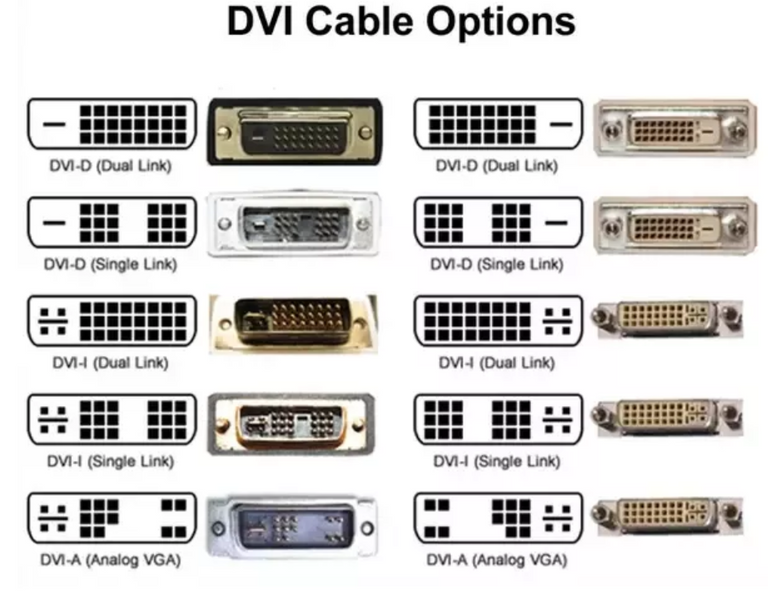
The standard was ready for obsolescence by design, though, because it required a separate sound connection. Although high quality sound connections were already separate at the time, the world was ready for superior sound and video in one connector by this time, and it soon had one. Enter HDMI, the second (and vastly superior) high def standard.
I get the impression that DVI was only ever meant to be a temporary standard, since HDMI incorporated a new type of copyright protection which essentially turned your high def cable into a kind of dongle- hardware without which HD content cannot be viewed. Although that’s not exactly an accurate description, that’s how I think of it.
Basically, the change to higher resolution was being taken advantage of as an opportunity to get a death grip on copyrighted material.
Meanwhile, the negative response to the DVI fiasco must have convinced them to hold to one version of HDMI for as long as possible. Otherwise there would have been no need for the display port. But it was never the standard at fault. It was the fact that one needed an unusual degree of understanding to use DVI at all.
This is just my guess as to the logic involved. Purely speculation based on the knowledge that TV standards typically don’t improve until the situation demands it.
For instance, HD resolutions were available for many years before an HD standard was adopted. Not for TV, but for computer monitors, which have always been non-interlaced to avoid eye strain. Interlacing is what made paused VCR recordings of television broadcasting blurry, because every other frame only drew every other line of the images. Computer monitors never had that drawback.
But broadcast TV remained interlaced until the demand for larger sets made the poor quality of broadcastings painfully obvious.
In any case, the new 4k standard has forced HDMI to meet modern expectations.

Neither connector- display port or HDMI- is inherently better. The situation changes with each upgrade of the standard. And now both standards improve every year or two. What you really want to know, then, is which standard updated most recently. That would be HDMI, which released version 2.1 in November 2017. HDMI - credit
But Displayport (really stupid calling it that, as the standard applies to cables, ports, and connectors together, and any video port on any computer has always been called a display port, so calling it that is hella misleading) will be doing theirs as soon as they can. They were supposed to do it last year, but that’s been put off perhaps a year and a half down the line. DisplayPort - credit
I feel Displayport is a lot better than HDMI for a few reasons.
First is simply that there is a clip to hold DP in place. Why they thought HDMI would be fine without one is beyond me.
Secondly DP has a much higher bandwidth. I run a 2k 144hz monitor and it will not even accept HDMI as it would not be able to carry the signal.
Third, you can daisy chain monitors with it. Meaning multiple displays from a single output.
Because of these I feel like it's the next step in the evolution. Akin to moving from serial cables to usb.
This post received a 22.01% upvote from @morwhale team thanks to @steemitcommander! For more information, click here! , TeamMorocco! .
STEEM Price : 4.873 $ ID : 1516678551000