When I had my Commodore 64, the Amiga was the computer I always dreamed of upgrading to one day. By the time I actually got around to upgrading, Commodore was almost dead and it just didn't seem like a wise purchasing decision as I was going off to college. I bought a 486 DX2-66 instead.
The Amiga 1000 was the original model released in 1985. It featured a 7.16 MHz Motorola 68000 processor along with 256 KB of RAM, custom chips for graphics and sound, and a custom multitasking OS called Amiga OS. It was not a cheap machine but it was an incredible value for what you got. It was succeeded two years later by two models: The Amiga 500 and the Amiga 2000. The core hardware mentioned above was still the same in both with 512 KB now being the standard amount of RAM on the Amiga 500 and 1 MB on the Amiga 2000.
While the Amiga 500 was the most popular Amiga for home users, it was probably the much more expensive and expandable Amiga 2000 (in the 1988 ad above) that made the Amiga a success in the professional world, particularly for video production, editing, special effects, and other video uses. While the Amiga 2000 started with the same core hardware as the Amiga 1000 and Amiga 500, it was much more expandable, containing five Zorro II expansion slots, four PC ISA slots as well as easier memory and CPU upgrade options.

The Zorro II slots were designed for the Amiga and provided a buffered extension to the Motorola 68000 bus. Zorro II cards used a protocol called Autoconfig that automatically assigned resources without jumper settings. This was similar to plug-and-play with PCI cards but was developed well before that. There were a vast array of Zorro II cards including network controllers, digital signal processors, graphics cards, SCSI cards, memory cards, and of course the immensely popular Video Toaster for video editing and just about anything else you can think of. Various PC bridge cards with processors ranging from the 8088 to the 486 were also available. These combined with the ISA slots in the Amiga allowed it to also become an expandable PC.
In addition to these expansion slots there was also a CPU slot used for CPU upgrades. There were two offical Commodore expansions for this slot as well as a variety of third party options. The original 68000 could be upgraded in this manner to a 68020, 68030, 68040 or even 68060.
The Amiga 3000 eventually succeeded the 2000 but the Amiga 2000 was on the market for four years until 1991. Several variations were available during that time including the Amiga 2000HD which included a 3.5" SCSI hard drive and controller, the Amiga 2500 which was an Amiga 2000 with Commodore's A2620 68020 CPU card and hard drive, the Amiga 2500/30 which was an Amiga 2000 with Commodore's A2630 68030 CPU card and hard drive, the Amiga 2500UX which was a unix variant with a tape drive, and others.
Read more: https://www.megalextoria.com/wordpress/index.php/2018/03/26/the-commodore-amiga-2000/
This was definitely before my time, but I really enjoy reading about 'ancient' or older technology. It's amazing to see the progress we've made. I had no idea you could run DOS programs inside of an Amiga OS window!
You could as long as you had the appropriate add-on. Macs had similar cards available for them back when the were 68k or PowerPC based, before they were essentially PC compatible.
Cool, never knew anything about the other Amigas and that the 1000 came before the 500, which is the computer I started with as a kid. Still got it:
Really loved that thing, learned programming (BASIC) on there and played point & click adventures (Indiana Jones and Monkey Island) for the first time, which is still my favorite genre to this day.
Never owned this computer, but I sure have great memories of playing around on the Commodore 64’s back in elementary school in the late 1980’s!
You were lucky you had Commodore 64s. My school had Apple IIs. They were ok but they were no Commodore 64s! :)
Yeah, great memories of 1989! 😆😂🤣
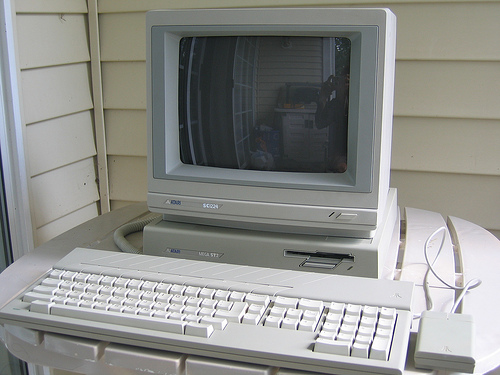
That was a beast of a machine. I had a Mega ST 2.