Introduction
In the previous two deliveries related to the phenomenon of the Doppler effect we have been demonstrating that this phenomenon is possible to capture it in any space-time of our existence, and how not to do it if it is originated by those sound waves audible to our ears, and as we know at every moment we can perceive any type of sound.
In relation to the above we have also highlighted the need to take into account the essential elements such as the source of sound generation and the receiver of these sound waves, since it is according to their mobility that we can analyze such a wonderful phenomenon, as we started to do in the previous installment with the example of the train analyzed by the great physicist Christian Andres Doppler.
In this opportunity we will continue knowing other very practical examples and that perhaps many of you have perceived it, but do not know the reason for the development of the difference in sound when a source emitting the same passes by us or on the contrary, it is we who pass by it and then we are moving away.
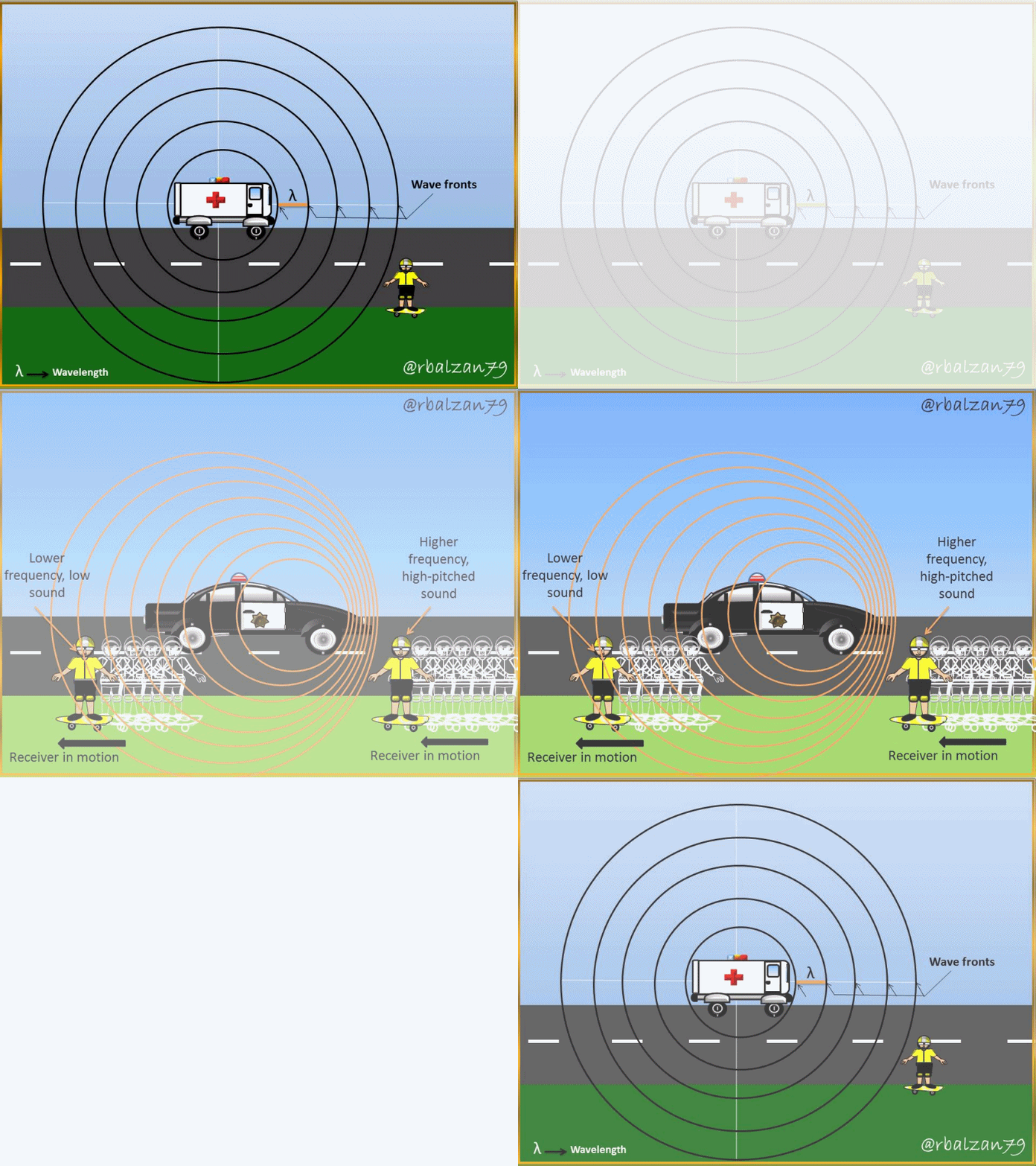
Therefore, my dear friends, as it has been expressed, the Doppler effect consists of a frequency change in the propagation of sound and this in relation to the relative mobility between a particular sound emitting source and the receiver or observer, so this undoubtedly leads us to the analysis of different cases and their mathematical formulations, therefore, we will continue to expand the examples linked to the Doppler effect as you can see in the following figure 1.
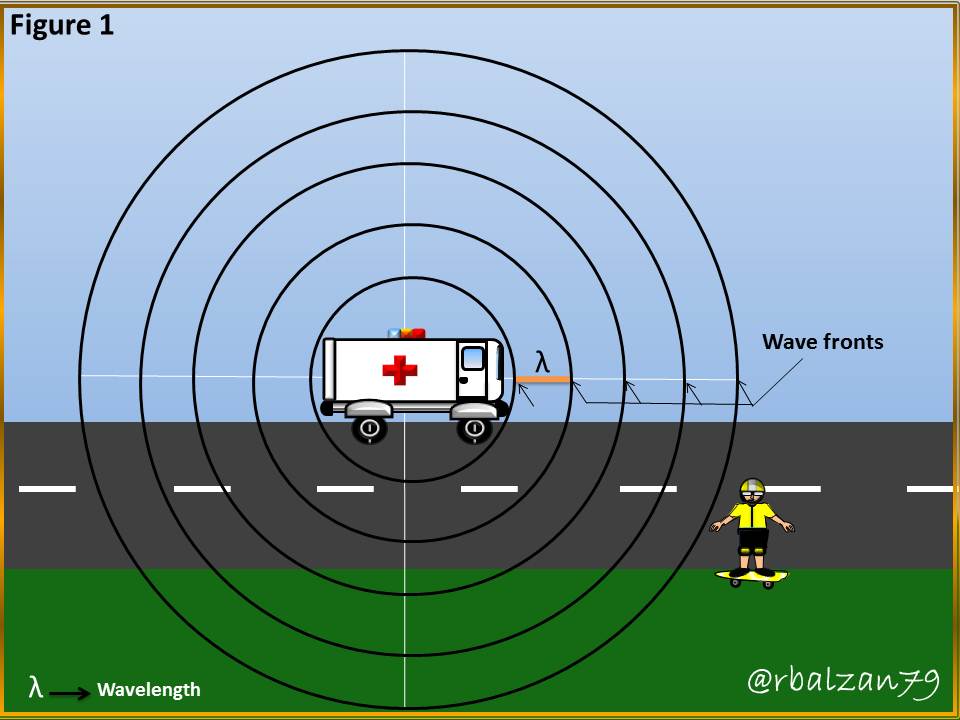
In the previous figure 1, it is clearly visualized how the source is emitting sound at a frequency (f), and in this way these wavelengths behave as concentric circles, and in this way with constant wavelengths, where we can determine them with the following formulation:

Now, relating the emission frequency of these sound waves to the above conditions, we have the following formulation:

Now we will analyze another example and the same with the source at rest and the receiver in motion, where, the speed will be represented as Vr (receiver speed), and this magnitude will be considered as positive (+) as the receiver approaches the source of sound emission and as negative as it moves away, therefore, observe the following figure 2.

In this way, the frequency perceived by the receiver in motion will be higher than the one perceived by the receiver at rest, where, the respective velocity between the sound waves and the receiver is (V+Vr) instead of Vr, this makes the frequency perceived by the receiver (fr) be according to the following formulation:

It is important to note that when the receiver approaches the source of the sound emission, it does so with a velocity greater than zero (Vr >0), where this positive value is considered when the receiver approaches the source of the sound emission, and thus it will perceive a higher frequency than when it moves away from the source of the sound emission.
Taking into account that the source of sound emission is the one that is moving (and the receiver is at rest), we can perform a similar analysis of the previous example, and thus, we would have that the speed of the source of emission of sound waves would be (Ve) and thus we would obtain the following formula for the frequency of the receiver (fr) under the conditions previously stated:

We must also take into account that for the analysis of the case, where both the transmitter and the receiver are in motion, we can relate the two previous examples, and in this way, form a formula for such a Doppler Effect case as shown below:

For the above analysis, it is essential to take into account the consideration of the signs in relation to the velocities according to the case to be studied, as expressed in the previous examples.
Conclusion
At every moment of our existence it is possible that we can perceive any type of sound waves audible to our ears, and when this happens usually develop a series of intrinsic phenomena such as those analyzed in previous articles as reflection, absorption, diffraction, refraction, including the wonderful Doppler effect.
And as we were able to analyze and demonstrate, we can say that in general terms the phenomenon of the Doppler effect is related to the change of the frequency of the sound waves which are perceived by a certain receiver, and also this character is intrinsically linked to the relative movement between the source of the sound and the receiver of the same, as we could observe in each of the previous examples.
Until another installment, my dear Hive.blog readers.
Note: The images are my own and were created using Power Point and the animated gif was created with the PhotoScape application.
Recommended Bibliographic References
[2]Specular and diffuse sound reflection. Author: @rbalzan79.
[3]Sound absorption. Author: @rbalzan79.
[4]Sound transmission. Author: @rbalzan79.
[5]Sound diffraction. Author: @rbalzan79.
[6]Sound refraction. Author: @rbalzan79.
[7]Acoustic or sound spectrum. Author: @rbalzan79.
[8]The human ear and sound. Author: @rbalzan79.
[9]Infrasound.Author:@rbalzan79.
[10]Educating ourselves with infrasound, Some sources of generation. Author:@rbalzan79.
[11]Educating ourselves with ultrasound. Author:@rbalzan79.
[12]Educating ourselves with ultrasound / Application in navigation. Author:@rbalzan79.
[13]Ultrasound technology applied in medicine. Author:@rbalzan79.
[14]Natural frequency of oscillation and resonance. Author:@rbalzan79.
[16]The Doppler effect and sound waves_Part II. Author:@rbalzan79.
Greetings @rbalzan79, it is important to highlight the relationship that you give to this natural phenomenon such as sound waves with physics, which for many can become an abstract science and that is basically why, because they do not see its application to everyday life.
Hi @sidalim88.
The phenomenon of sound plays an important role in our lives and that is why we are interested in knowing as much as possible about it.
Thank you for your extraordinary contribution. Greetings and many successes.
Thank you @edu-venezuela community for such important support. Greetings.