Language Marathon
It's been 140 days since I started learning Japanese on fine morning. It is tough, I sometimes feel like I am torturing myself for no particular reason, but it is going well, I guess they don't call it masochism for fun, or do they! I know the date accurately, thanks to my somewhat regular posting at hive. I wrote this post on Oct 06, 2025. That is 140 days back. Also my DuoLingo Japanese streak is 141 days today! Phew!
I have written quite a few posts on this struggle and these posts are also a reflection of my data analysis prowess and my curiosity of generating different types of charts and plots, with an inclination towards statistics. I have enjoyed writing the progress or lack thereof:)
Still DuoLingo
Yeah, I am still at it, among other things (LingoDeer). Duolingo follows a simple hierarchical structure: Lesson → Unit → Section. In practical terms, the Duolingo Japanese course consists of roughly 4,800 lessons, grouped into about 221 units, which are further organized into six learning sections. Importantly, neither the units nor the sections are uniform: different units contain different numbers of lessons, and each section spans a different number of units. One thing that took me a while to fully wrap my head around is the Duolingo score—especially for Japanese. At first glance, it looks like a proficiency metric, something you might be tempted to equate with JLPT levels or “how fluent” you are. In reality, it’s much closer to a course‑completion indicator than a true measure of language ability.
For Japanese, the score currently runs from 0 to 130. That upper bound isn’t arbitrary: it corresponds to finishing the entire course path. In other words, as you work your way through lessons, units, and sections, your score gradually increases, and hitting something close to 130 means you’ve essentially completed all available content.
✅ Total sections: 6 core sections
(With an additional non‑progress section for review)
| Section | Typical name (varies by UI) | CEFR focus | Units |
|---|---|---|---|
| Section 1 | Rookie / Intro | Intro / early A1 | ~9 units |
| Section 2 | Explorer | A1 | ~30 units |
| Section 3 | Traveler | A1 | ~30 units |
| Section 4 | Trailblazer | A2 | ~60 units |
| Section 5 | Adventurer | B1 | ~50 units |
| Section 6 | Discover | B1 (advanced) | ~42 units |
| Daily Refresh | Review only | — | no new units |

My Progress
After 140 days, I am at Section 2, Unit 14. So I have done about 23 units in 140 days.
Days practiced: 140
Units reached: ≈ 23
Average lessons per unit: ≈ 21–22
Total lessons per course: ≈ 4,806 over 221 units
Speed≈140 days -> 500 lessons -> 3.6 lessons/day
In the plot above, I tried to plot various standard speed, and marked my current position. I am currently plotting little above 3 lessons/day line, which is just barely above average. At this rate, I am looking at 3-4 years to complete the course, and gain some sort of B1 level proficiency as per CEFR scale, but that is a DuoLingo claim. In reality CEFR B1 describes functional, real‑world communication across skills. Most learners agree Duo alone can't help anyone achieve that. Not right now anyways. I have written extensively about Language proficiency standards here.
⏱️ Time to Reach Score 130 by Learning Speed
| Lessons per day | Days to reach score 130 | Approx. years |
|---|---|---|
| 1 | 4,806 | 13.17 |
| 2 | 2,403 | 6.58 |
| 3 | 1,602 | 4.39 |
| 5 | 961 | 2.63 |
| 10 | 481 | 1.32 |
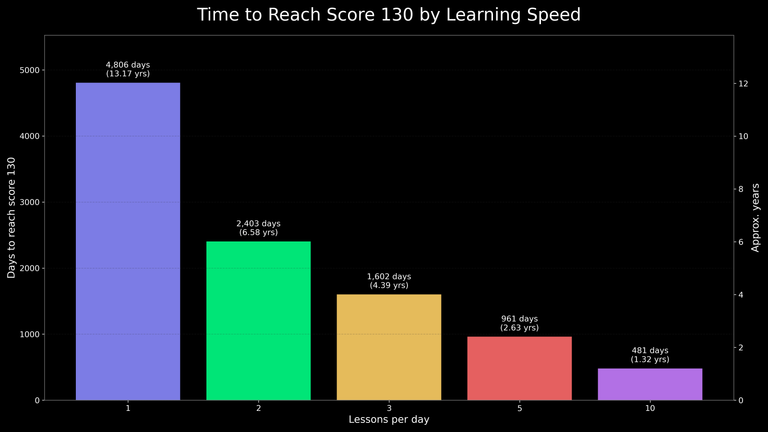
So there you have it. The confusion is common. Reaching a Duolingo score of 130, i.e., completing the entire Japanese course—puts someone comfortably around JLPT N4 level, with some exposure to N3‑level vocabulary and grammar. However, it is unlikely to be sufficient on its own to pass JLPT N3, which requires targeted reading, grammar classification, and exam‑specific practice that Duolingo does not emphasize.
Realistic JLPT equivalence
| Duolingo status | CEFR (Duolingo claim) | Realistic JLPT outcome |
|---|---|---|
| Early sections | A1 | JLPT N5 |
| Mid course | A2 | JLPT N4 |
| Full course (Score 130) | B1 (internal) | Solid N4, some N3 exposure |
So, bottom line, even after 3+ year of study I may or may not be conversationally proficient in Japanese. That is a potential reality that I need to warm up to! Phew!


Masochism--it does sound a little like that :)) Also very impressive, especially the graphs.
I love languages, but I wouldn't torture myself with such discipline :) For me it was always enough to be able to communicate. It didn't matter to me if I did that badly. I spent years studying German and Spanish--without attaining true fluency. I took a Berlitz course (10 lessons) in French and at the end could actually understand a bit of the language. Same with Italian...although I never studied it, my mother used to talk with my relatives in Sicilian (which is a language distinct from, and older than, Italian). After your last blog I started with DuoLingo in German, to improve. After a few lessons, I stopped. It wasn't fun. I'd rather listen to movies or TV shows in German and pick it up that way. I think I'll have to find a subscription to media beamed from foreign countries. That I think would be great fun and a more natural way to learn--other languages also. Did you ever try that with Japanese? With English captions? Probably too casual and slow for you.
Certainly wouldn't be able to graph that progress :)
Good luck!!! And, remember to have fun.
Masochism indeed :)
I didn't want to use the word, but meant it. I am glad you picked on it :)
DuoLingo is not the only item I am using. I am too deep into it, but again my issue is, I probably spend more time analyzing various language learning tools as opposed to actually using them :)
You see @livinguktaiwan mentioned LingQ above and I am checking it out!
I started off learning Spanish using Duolingo and was surprised that I regularly topped the league table when I was just using it about half an hour a day. I reckon those league tables are fake and everyone tops it as an encouragement.
Anyway, after learning for about month, I reckon I could say a few useful phrase like asking for a table at a restaurant, and asking where you're from, plus a bunch of vocabulary. I dunno how much progress I would have made if I kept up with it like your have.
Now I've switched to another app, the idea is if I paid for it, I'm going to force myself to learn it.... Going to put an hour in my daily schedule now
Oh, I pay for it! I have a family subscription. Kids are on it for French. Also Duo is not all. I have LingoDeer plus, text books plus lifetime Bunpro for grammar. I have spent nearly $500 on this already:)
I'm using LingQ, sometimes I import Spanish posts from friends here and make it into a lesson, I find it much more interesting learning something "real" if that makes sense
You are doing in a good pace!! I admit that sometimes is even difficult to keep 2 lessons a day...
Thank you. But 3/day won't do much for me!
Whoa really interesting data presentation here.
I also started learning Japanese on Duolingo a while ago. I failed miserably at writing Hiragana, Katakana, and Kanji. I'm only playing chess now on Duolingo just to keep my daily streaks and monthly challenges:D
I am still sticking to it. A few of my family members and friends are also learning with me, that helps.
Very impressive! That's a big commitment you have accomplished there!
Marathon