
For a long time I avoided writing this post.
When Bitcoin was roaring upward, anyone criticizing it was dismissed as bitter, jealous, or “coping”. When number-go-up becomes the only metric that matters, dissent sounds like heresy. No one wants to hear about first principles while their portfolio is doubling.
Now that Bitcoin is in a bear market, the dynamic flips. Any criticism will be written off as panic, sour grapes, or hindsight rationalization. So be it. This isn’t about price. It’s an autopsy.
Bitcoin didn’t fail. It was repurposed.
Bitcoin, at its inception, was not about getting rich. That statement alone will irritate a large percentage of readers, which tells you how far we’ve drifted. It was about changing the financial structure of the world. It was a noble vision, a very idealistic one, somewhat utopian even. Possibly naïve.
Satoshi Nakamoto did not publish the white paper to invent a casino chip or a speculative asset class. Bitcoin was conceived as a decentralized currency, one that did not require trust in banks, governments, or financial intermediaries. We all repeat "decentralized" ad nauseam, but it's worth thinking about what that actually means.
It was explicitly designed to sit outside the existing power structure.
The goal was independence.
The goal was resilience.
The goal was exit.
It was not “early retirement”.
Then something happened. The first cohort of Bitcoiners got rich. Not comfortable. Not independent. Rich. And just like that, the narrative shifted.
Bitcoin was no longer something you used. It became something you held. Something you hoarded. We even changed the tag line. It was now "a store of wealth". It became something we stared at while refreshing charts, waiting for the next pump, trying to time our next buy or sell to optimize how much money we could make.
This is where the original sin entered:
envy

Not the crude kind. No one calls it envy. We upgrade the vocabulary. We call it aspiration. We call it “life-changing gains”. We call it “financial freedom”.
But the psychological engine is the same. Everyone wanted what the early adopters had. Instead of buying Bitcoin in the hopes of changing the world, we bought it with reassuring cries of "it's still early", hoping to be the next Bitcoin Millionaires.
And once that desire took hold, Bitcoin’s trajectory changed permanently. Because if the goal is wealth extraction, decentralization becomes a liability.
Bitcoin does not rise on ideology alone. It rises when capital flows in. And once the community collectively decided that “number go up” mattered more than independence, the next step was inevitable: invite Wall Street in.
After all, who has more capital than Wall Street?
ETFs. Custodians. Institutional wrappers. Regulatory blessing. All of it marketed as “adoption”.
But it wasn’t adoption. It was assimilation. Think the Borg. Bitcoin wasn’t transforming the system — it was being absorbed by it.
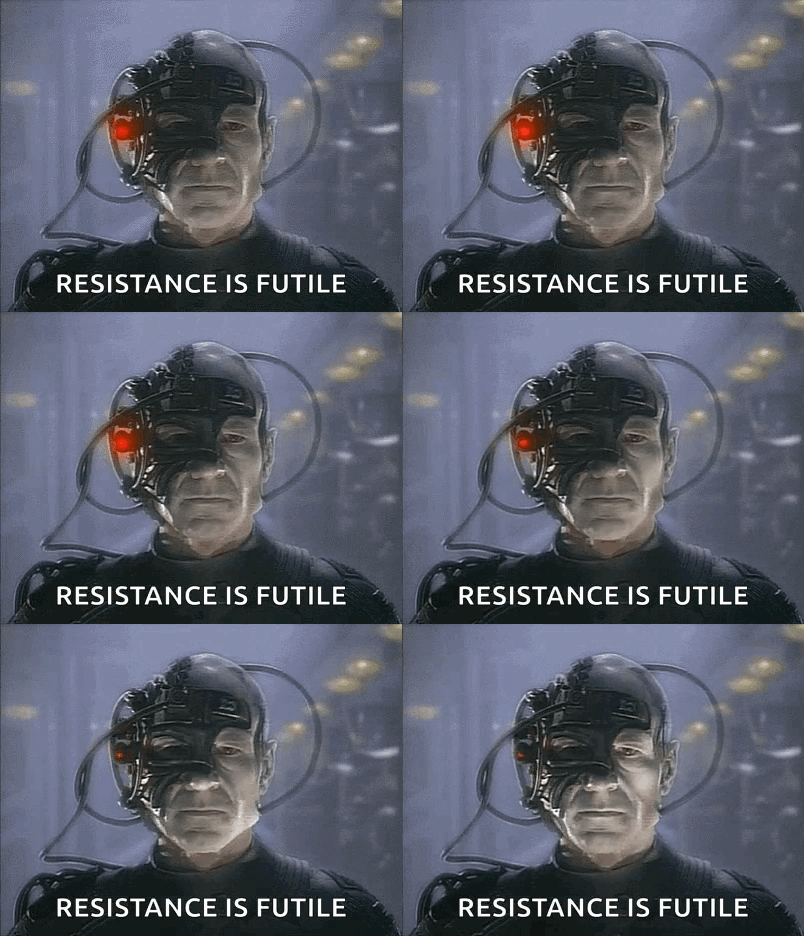
And the most damning part? This was not forced. It was welcomed.
It was celebrated.
We all watched the charts when the first ETF appeared and were completely overjoyed. "This will bring Bitcoin to the masses" is the lie we told each other, as our eyes were plastered to the charts and we drooled while watching the numbers climb. Because what we really meant was: "this will push the price higher."
Because everyone wanted to be rich.
At this point, Bitcoin is no longer meaningfully independent from the financial system it was meant to bypass. It trades in correlation with risk assets. It reacts to Federal Reserve policy. It is held in custodial products that recreate the trust structures it was designed to eliminate.
The rhetoric still invokes freedom, but the mechanics tell a different story. Bitcoin is now financialized.
That doesn’t make it useless. It doesn’t make it worthless. Hell, I'm still heavily invested in it, and will continue to be.
But it does make it something fundamentally different from what it was meant to be. The idealism long ago gave way to greed. Or... let's say capital gravity.

People ask why Satoshi disappeared.
No, it’s not because his name was Epstein. That rumor being pushed by journalists may be the dumbest thing of 2026 so far. So far, mind you. I'm sure Trump is working at the moment on topping it.
His disappearance is often framed as myth-making. Some figures, like Michael Saylor, elevate him into a near-religious figure who vanished so Bitcoin could “win”. I'm still not quite sure what exactly that means or what Saylor is smoking.
But I’ve never found the disappearance mysterious.
If you created something to liberate individuals from centralized power and watched it slowly morph into just another vehicle for wealth concentration — why would you remain involved? Why would you stick around?
The coins attributed to Satoshi that are now worth billions remain untouched. That fact is often treated as trivia. I think it’s the most honest statement in the entire Bitcoin story. I see it as a statement. He didn’t want the money.
That may seem shocking and absolutely ridiculous to most people because to people who want to be rich, it is inconceivable that anyone who not want that. But let me repeat: He didn't want the money. Not everyone measures success in dollars.
He wanted to change the rules. He wanted to change the world.
And once it became clear that the world wanted riches more than freedom, that the very people he was trying to help would immediately give up on the dream as soon as wealth became possible, he walked away.

This is the uncomfortable part.
Bitcoin wasn’t corrupted by outsiders. It was corrupted by its own community: by people who said they believed in decentralization, but believed in personal enrichment more. Wall Street didn’t storm the gates. The gates were opened.
And once that happened, Bitcoin stopped being a rebellion and became a product.
None of this means Bitcoin goes to zero. None of this means another bull run won’t come. There likely will be one. And it will likely exceed prior highs. Price cycles will continue.
But philosophy has already shifted.
Bitcoin today is not an independent currency fighting the system. It is part of the system. A volatile part, yes, but still integrated, still governed by capital flows, still shaped by institutions far larger than any individual holder.
That doesn’t make you foolish for owning it. It doesn’t make you immoral. It just means we should stop pretending.
Bitcoin didn’t fail. We changed the goal. And we shouldn’t be surprised that we arrived somewhere different.
What do you think? Am I being too harsh? Am I nuts? You probably all think I'm nuts. Watching the price of HIVE drop to 7 cents must have gotten to him, eh? @azircon, send me one of the funny videos you've come across in your Japanese language study to cheer me up!
Look, I'm not saying I'm getting out of BTC, ok? If anything, I am buying more while it's low. I kind of think it might go lower, but I'm buying on the way down with the expectation that it will eventually go back up. I've just been disappointed for a long time that the revolution seemed to have quietly fizzled out and disappeared as people decided being rich was more important.
I know I'm not the only one who has started to feel something has been lost. @ericvancewalton has expressed similar feelings, as has @bozz. I'm sure others have thought it as well.
Again, I am remaining here. Just as I remain invested in the US stock market. We have to survive in this modern world, and playing the markets remains one of the best ways to do just that. But I am sad that something has been lost.
❦
 |
David is an American teacher and translator lost in Japan, trying to capture the beauty of this country one photo at a time and searching for the perfect haiku. He blogs here and at laspina.org. Write him on Bluesky. |
Very well said man! I am a principle person in a lot of ways. I think we should strive to be more principled, because when more people were, that's when the world was a better place for the average person, in my opinion.
People were cheering left and right about the ETF's and other financialization of ol' bitty. I was on the other side saying "be careful what you wish for" and was called an asshole.
I think bitcoin is for sure much less of a libertarian perspective than it has ever been. Hell, most of the people now that are in "crypto" are not at all libertarian and are far more subservient pansies and bandwagoners. I am certainly not perfect but I would like to think that I have principles that help me retain what some of the original aspects of bitcoin are meant to be.
Where we go from here is a tricky part - can we regain financial freedoms that we started to explore?
As was I. The hype was so strong than anyone questioning it was attacked. The allure of wealth is just too strong, I suppose.
I don't know. It won't be with BTC. We can still trade that one, but it's now part of Wall Street and is little different from trading any stock. I'm optimistic that smaller alts like HIVE might continue to fly under the radar and escape the increasing regulation. Price-wise, we will continue to be heavily correlated to BTC, I guess, but maybe we can carve out a space where we care more for those original ideals than money. But I don't know... Hive is currently controlled by a cartel of its own that makes it even less decentralized than BTC has become. So... I don't know.
Yeah for sure it's going to be the alts that reign supreme in terms of the tenants of true decentralization and crypto's principles. I know that places like Hive have their own issues with that, but I think we are making moves in the right direction. Whether those moves have enough of an impact is to be determined.
I think at this point with Bitty, I'm going to keep it until it serves my purpose. I am hoping to be able to trade it or sell it for something important. Whether that happens or not remains to be seen, but at least I can get something out of it instead of holding it forever.
I look at economies that have devolved, or have not yet evolved. The resourceful survive. The flexible. Can't be set in a 'profession' but have to respond to the dynamic of the economy. Something as basic as knowing how to fix things becomes important. People create opportunities in microeconomies--selling to each other. Almost everybody is an entrepreneur, neighbors selling and buying from each other.
My husband and I are living on pensions and Social Security. That model won't be here in the future, I think.
Owning assets...a piece of land, a home, tangibles such as gold and other metals. That's the only security I see. Translates from one economic model to another.
Does this sound post-apocalyptic? I don't see good things coming. There isn't a lot of hope in the young, and I think they are right.
Oh for sure! It's incredible important to be able to trade things with our neighbors, the local people around us. I do it all the time, and people have done it for millenia. We trade favors. I know how to fix X, Y and Z and I tell my neighbor about it if they have a problem they talk about. We then figure out minor ways to help each other out.
I think the days of working in a single spot on a factory floor are gone. Specialization is okay in some categories but being siloed is detrimental to society as a whole, in my opinion!
It sounds a little apocalyptic but it's a cycle, unfortunately. Hard times create hard men. Hard men create good times. Good times create weak men. Weak men create hard times. If we look at history with this lens, it lines up pretty accurately every half century or so!
I came of age in the 60s. I went to NYU, one of the centers of cultural rebellion. Satoshi would have fit right in. There was an almost universal contempt for profit, for self enrichment, certainly for 'the establishment'. There were three schools: business, education, liberal art. Those of us in the liberal arts program held business students in low regard. We wanted to change the world. We wanted to lift people up. Peace Corps mentality, without the aspiration to foreign service.
You say, bitcoin "was explicitly designed to sit outside the existing power structure." That's a sixties thing, that's something I can relate to emotionally.
There will be another Bitcoin, I think. Hive is sort of an alternative, though there still exists a power structure here that exerts control over the 'bandits', those who would exploit the platform.
Yes, I'm staying. Hive is still beautiful to me, as I occupy my little corner of this platform. No, not the stock market. I can't play with the big boys over there. There is no safe corner for people like me in the stock market. I will survive. There aren't that many years left. Will my children? My granddaughter?
I don't know.
I would have enjoyed going to NYU at that time. I still feel the same way, but rebellion becomes harder when you have to provide for kids.
Well, that's the question. The world is changing so quickly. There are two sides to the coin, as always, but the bad side has become so much more dire. I do worry about my kids future.
You nailed it on the head. It was about independence from the financial system, not to become rich. And now that's all it is, a way to earn money and has been incorporated into ETF's. It's exactly the opposite of what it was meant to be. I understand why the creator took an exit stage left, he didn't want it centralized.
As with much of the rest of the world communities can corrupt the initial values and intent of anything. I guess it's the way of the world in the end...
I guess it is somewhat understandable. Our uber-capitalist world increasingly punishes anyone who is not chasing wealth, so it is hard to get angry at people for giving in to that fear and desire. But it is all unfortunate.
Very well said, @dbooster. The Cypherpunk ideals associated with the early Bitcoin community went down the same path as a lot of communes did in the 60's and 70's—people trying to build an alternative way of living outside of mainstream society. I was introduced into the world of crypto later, in 2016 and so much of that original ideology was still alive. However, I saw it beginning to fade as early as late-2017 when people started talking about exit numbers and Lambos. I'm so thankful to have lived through a sliver of time before everything was diluted. It really was like a dream and we were certain it would change the world. Bitcoin did change a lot of individuals' lives and, in some ways, changed the world a little bit in the process. I have no idea where it all goes from here, at this point it's probably too big to fail. It's certainly not a revolution anymore but another asset class, one that most people will have a portion of their portfolios exposed to for many decades to come. One thing is for sure after this last bull market, it's now being effectively manipulated by those who control all of the other assets. As long as they have a large stake in it it'll probably continue to grow in a measured way. Good work with this post. This is one of the best pieces of writing I've seen on Hive in a long, long time.
Thank you. I'm glad you enjoyed the piece.
I was also able to get into this space at the very tail-end of that. That late 2017 bull-run is really what killed the original attitude for good. It was great to see the idealism at that time.
I think you are spot on. This post has a lot of good points and echos a lot of things I have seen from other people. Do you think we are in a bear market now? Not just a lull in the bull market? It's hard to even quantify those terms anymore when it comes to crypto.
No idea 😃 We probably can't call anything yet. But it sure is acting like it wants to be in bear season.
The chart is true on how meme status ruins real analysis.
Spot on ! I have a feeling that the end state of Bitcoin will be like the Talents of the Classical Greek world. Something so individually valuable that it is only useful for transactions between states.
As time goes on, more and more BTC will be bought by institutions, and even more will be gathered up by governemnts. "Confication of criminal assets" or "Strategic reserves", however they want to dress it up, the result is the same. Those of us with small retail holdings will eventually see a price where we'd be stupid not to sell, especially as the price can be manipulated to trash our value if we hold out too hard.
Eventually, BTC will just be something that lives in government vaults, a kind of digital Fort Knox. Private ownership may even be outlawed. The government reserves will underpin endless printing of worthless fiat CBDC's, with the (untrue) claim that it's something of value backing the currency they issue.
It's a shame, the project held so much promise. Let's all work hard to make Hive a success so that HBD (along with Monero and one or two others) can remain a stablecoin truly outside the control of governments and the legacy financial institutions that are part of them. Just a shame most stablecoins are pinned to the failing dollar - I reckon we should move HBD to gold-pegged.
Posted using The BBH Project
Remember the fact:
World doesn’t need crypto, it is crypto that needs the world.
Here you go, this should cheer you up!
Here: this one for extra credit!
大丈夫ですか